Showing posts with label Haiti. Show all posts

Saturday, December 17, 2016

Haitian Businesses Update

This week I had the opportunity to revisit the solar powered cell phone charging businesses we helped to start back in the Summer of 2015.  For the back story, see my older post.

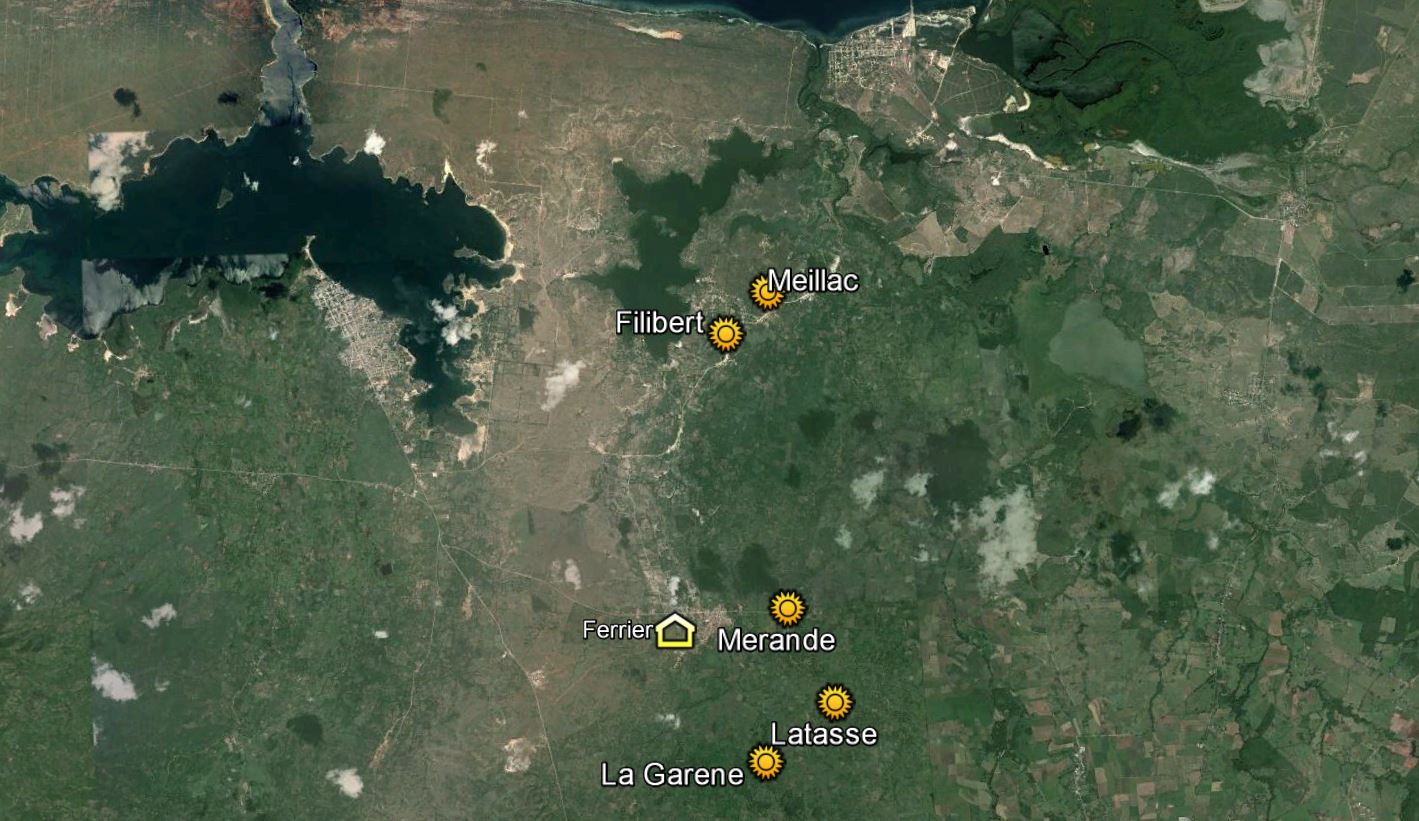
If you recall, or even if you don't, we launched a network of five family businesses in small villages around the area of Ferrier, in north east Haiti.  See the map below.  Of the four I was able to visit, all were in good working order but have had different levels of financial success. Read on to find out why!

[this is what it looked like out the window of my plane]

Business #1: Merande
The first business we visited was the closest to Ferrier: Merande.  It's at the home of a man called Lele, like a ukelele without the uke.  He is a gregarious man about my age. Talking to him tends to put me in a good mood because he's so welcoming and charming.When he saw me he said "mwen kontan we ou!" which literally means "I content see you".  I told him I was happy to see him too and he just laughed!  I guess he thinks it's funny that I try to speak Kreyol.

Lele had painted a sign outside his door advertising his business.  He references Psalm 23 in French which I believe says "The Lord is my burger" or something like that.  I don't speak French.

[marketing by Lele, store operated by Lele's son, cell phone charging for 5 Gourde or about a dime]

[The solar panel we put up on top of a frame was in good shape 
and was helping to provide support for a clothes line, #multitasking]

Despite the good working order of the equipment and the compelling signage advertising the business, he isn't making much money. Since our installation 18 months ago, the national electric grid has been extended to parts of Merande. Some homes have been officially connected to the grid, and many others have made unofficial (illegal) connections to it!  It's hard to sell something everyone is getting for free!  

Business #2: Latasse
Next, we drove on to Latasse. The roads were very muddy so we had to park and walk the last 20 minutes or so.  Once we arrived we found a similar situation.  Pierre was happy to see me, the equipment was working well, but business had slowed.  The grid hadn't been extended out that far, however, so what was the source of the competition?  

[Pierre and his storefront]

[pole-mounted solar panel, and two smaller solar panels from another Mission Waco program, see red circles]

Pierre had raised the solar panel on a pole to get it up out of the shade. That seemed to be working well although it makes rain the only source of cleaning.  But a more significant problem were the smaller solar panels such as those shown on the right.  Through another project with Mission Waco, a large number of these panels had been made available in Ferrier.  Apparently, some of them have found their way to Latasse and are now providing a new form of competition for the cell phone charging businesses.  They are not as powerful, but they are capable of charging one phone at a time. This is a second type of competition that didn't exist when we installed these systems!

Business #3: Filibert
Moving on to Filibert, we found the same thing.  Happy people, functioning equipment, and new competition.  Although they were making good income from the business (about $1/day) they said it was down some.  They said something about the Digicel tower further down the road, but I didn't understand.


[A new fence and a watermelon plant now keep company with the solar panel. The watermelon is another type of solar powered device.  It converts light to food.]

[Happy kids]

Driving a bit further down the road, however, we came to a new cellular antenna tower.  Digicel is a major cellular telephone company in the Caribbean and Central America and their new tower had its own large array of solar panels since there isn't any other source of electricity out there.  To keep people from stealing the solar panels they surrounded them with a concrete wall topped with razor wire and hired a security guard. We spoke with a woman nearby who told us the security guard was running his own cell phone charging business with the electricity from the tower!  Unbelievable. She also had a power cord stretched through the razor wire to power her house. Not immediately understanding why there was a power cord, I asked my translator, Guy, to inquire about it. He understood she was stealing power and didn't want to cause trouble by asking about it. He wisely put me off until such time that he could explain it to me discretely.  Maybe he was afraid the woman would beat me up if she thought I was from Digicel corporate headquarters or something.

[Laundry drying on the bushes near the base of the Digicel antenna tower]

[Digicel's large and expensive array of solar panels - and the source of both
 the neighbor's electricity and the security guard's side business!]

[Guy is keeping me from getting into trouble with this lady who only responded to the pseudonym "Heisenberg"]

Business #4: Meillac
Moving on to Meillac and our most successful business, we came to Sonja's house.  From the beginning of this project she seemed to be the most aggressive businessperson, the most sure she could make a profit, and the most remote.  These attributes are working well for her.

As we pulled up to her house, another woman was just leaving with her newly charged cell phone. Sonja invited us in and told us that she was making $2 or $3 a day with her business - easily double what we had hoped and budgeted!  

As she was 18 months ago, she still avoided eye contact and seemed to be uncomfortable talking to me (I have that gift with women) but she answered our questions.  In the pictures you can see that she is charging some of the batteries directly. That is, she has taken the battery out of the phone, presumably because she didn't have the correct adapters for the various types of phones, and has modified chargers by cutting off the phone connector and attaching the wires directly to the battery terminals. Ingenuity!

 [phones and phone batteries being charged, some by direct connection of wires without plugs!]

[Sonja's house with a roof-mounted solar panel]


[uncomfortable but important video interview with entrepreneur Sonja of Meillac, Haiti!]

Business #5: La Garene
We didn't have time to make the circuitous trip to La Garene. It takes 30 minutes to walk there from Ferrier (on footpaths) but nearer to an hour to drive there (on rough roads).  Because of its proximity to Latasse, my guess is that they would be in a similar condition.

So where are we?
What did we learn from this visit?  We learned that our engineering was pretty good: the electronics, panels, batteries, etc., have held up well.  We also learned that the owners still seem to like them and use them.  We also saw examples of how much ingenuity can be found among people in severe poverty. 

But most importantly, we learned why some of the businesses aren't making as much money as we expected. There are three new types of competition that did not exist when we installed the systems in May 2015:
1) extensions of the national grid which brought electricity to more homes through both legal and illegal connections - we can't really complain about this since any type of electrification diminishes poverty in a multitude of ways
2) small solar panels flooding the region from another, different poverty abatement project are also taking away business in some areas - while this is good for the region as a whole, it's not so good for our businesses
3) unsanctioned businesses operated by the security guard of another power source (Digicel).

And where do we go from here?
So what we need to do is identify new revenue streams (that's fancy business speak for ways to make money) that our businesses can harness in ways the competition cannot. If the small solar panels can't produce as much power, what services could we provide that use more power than that competition can provide? How about a "cinema" that shows movies on a television?  How about a barber shop that uses electric trimmers? How about a refrigerator that makes ice or cools soft drinks? Help us think of other businesses - leave it in the comments!


Monday, September 21, 2015

The Whales, They Love Me

Three things made today a great day! Three things happened that punctuated my day with excessive exclamation points and weeping-for-joy emojis. Three brief surprises burst forth from the surface of a day, otherwise characterized as "pretty good," like three blue whales breaching the surface of the ocean, showing me their bellies and yelling in whale language, "we love youuuuuuu!"

It all started like this: I got up early (for a Sunday) and met a few hundred other folks for the Mission Waco Walk for the Homeless event at 8:00 AM. It was a walking tour to visit several of the organizations around town that provide services to homeless folks. It was part advocacy, part education, part cardio. As the crowd walked from the shelter to the food bank to the veterans services building and so on, a delightful group of bikers blocked traffic for us like motorcycle cops at a funeral. They did a great job keeping us from being run over by early service Episcopalians.

Then I noticed that one of the bikers was my friend Paul who has a cool beard and a pony tail and plays bass.  Sometimes his band, The 10th Leper, plays music at Church Under the Bridge.  All these things make Paul pretty cool in my book. But to top it all off like the whip on top of my low fat caramel macchiato - today I found out that he rides a Harley!

[This photo taken from Paul's facebook page is credited to Souther Photography]

He agreed to let me ride on the back of his bike for a few blocks and it was fun to ride in the open air on this beautiful morning in downtown Waco. Its engine grumbled "potato potato potato" noises like a panting dragon.  Bucket list.

After rejoining the crowd I had the privilege of walking alongside Judge Ken Starr. He and his wife Alice were also participating in the Walk for the Homeless, though sadly he missed the sight of me on the hog.  He was very interested to hear about what Engineers with a Mission had been doing in Haiti with JAMES and Mission Waco. He was particularly excited to hear about our new Humanitarian Engineering program at Baylor. He and Alice were so attentive and engaged, and their support means a lot to me. Towards the end of our conversation, he told me something very exciting! Unfortunately, I don't feel the liberty to put it on the internet!!  So the second high point of my day will have to be redacted like Hillary's emails released by the State Department.  He said ahey! you think you're clever getting past my redactions   and that kkdk alk kdakkllkja  aklsdfj.  What's that you say?  Anticlimactic? All that buildup just to be redacted?  Yes well, you're right, it is. What can you do?

[Left to right: Jimmy Dorrell, CEO of Mission Waco
Rob Wolaver, President of Texas State Technical College, Waco
Johnette McKown, President of McLennan Community College
Ken Starr, President and Chancellor of Baylor University
Photo courtesy of Dr. Adam Ecklund, and by "courtesy" I mean stolen from his facebook page without permission.]

The third highlight came later that afternoon. For reasons you might not expect, I purchased a handgun. In fact, I bought my first ever firearm, a .357 magnum revolver.  You see, ever since, like, three months ago when I started thinking about doing humanitarian work with water wells along the Texas/Mexico border, I have been thinking about snakes. In my search to buy a snake gun, I had the opportunity to fire a friend's .357 at night. In the darkness, it was easy to see the huge fireball shoot out of the barrel. And the sound was so loud that it literally made my ears ring. This induced in me some kind of testosterone power pose that normally only comes with watching Monday Night Football or using a large chainsaw. I was hooked after one shot like a junkie.  

[My new gun is on order and won't be in for another week or so. In the meantime, please enjoy this likeness of an European American Armory Corp. Windicator .357 Magnum Revolver.]

So there it is: my three awesome things that happened today. I realize, looking back on them, that these things paint a picture of me. I'm afraid they make me look a bit like a redneck. Not that there's anything wrong with that (jk, I think there is) but in my case, it is simply not true. I refuse, in fact, to be defined by political stereotypes or other social expectations. I simultaneously care about social justice but also own a handgun. I frequently have the privilege to converse with both homeless people and university presidents. I like Harley Davidson motorcycles, but never plan to own one. I am pro-immigration, but also pro-rule of law. I am neither a libertarian nor a socialist. I do, however, speak whale.


Wednesday, August 12, 2015

Solar Micro-businesses in Haiti

This May, Engineers with a Mission (EM), Baylor Missions, and Justice and Mercy Engineering Society, (JAMES) brought solar energy-based businesses to Ferrier, Haiti, one of the poorest areas of the Western Hemisphere. Mission Waco, the parent organization for JAMES, has had a presence in Ferrier for over 30 years and this was the third annual trip to the area. The longstanding relationships between Mission Waco and the Haitians there are the backbone for the development work done in north-east Haiti.


This year’s solar project was unique in that we had not one, but five installation sites in the areas surrounding Ferrier. We placed five 250 Watt solar panels in the care of carefully selected impoverished families to operate as cell phone charging businesses. These bless the families with a source of income and stimulate the local economy.  Although there is intermittent electricity access in the larger town of Ferrier, the outlying towns of Meillac, Filibert, Merande, Latasse, and La Garene have virtually zero access.  Cell phone owners must pay and often travel to recharge their phone battery.


Financial sustainability is an important goal for all our projects, even if we don't always achieve it. For this reason, we carefully chose to operate the solar systems as microbusinesses. An association was formed between JAMES and the five families, and a contract was signed. As part of their contract the families must pay 45 Haitian Gourdes from their daily earnings (approximately 1 dollar U.S.) as a rental fee. This fee is placed into a savings account to be used to cover future repairs and battery replacements. Borrowing an idea from the micro credit industry, the families have group liability for these rental fees – if someone can’t pay, the others are responsible for covering the fees. Ten weeks after launching these businesses, the rental fees have been 100% paid and about 3200 cell phones have been charged!  Another part of their contract requires that they use the energy they harvest to host gatherings for the community, whether it be setting out a light for children to do school work, hosting church activities, or simply letting the locals play dominoes at night.

[the indoor unit: charge controllers, switches, fuses, inverters, batteries, and a handy table top for holding phones while they charge]

[each family business also has a 250 Watt solar panel mounted near their home]

[part of the team, and seemingly most of the village, commissioning another system]

[while most of the solar panels were ground mounted, this home had a nice flat section of roof that was more secure]

These families were not selected at random. Our friend Zenas, a local pastor with a passion for serving the poor, chose these families because they are Christian leaders in their community. These solar panels are a tool for our Christian brothers and sisters to continue to bless their community.

This year we took a team of 16, 3 professors and 13 engineering students, forming our largest mission group yet. But our team was even larger than this! Our Baylor students worked right alongside local handymen, pastors, carpenters, guides, translators, and community members eager to help.

[Watching everyone do their part reminded us of the body of Christ;
everyone is different but each plays a part.]

We intentionally seek out locals to be a part of our team because it helps our team remain relationally grounded and helps further develop the community.  Hiring out Haitians is a way to provide a source of income to families as well as affirm their talents. One sweet example of this was when our guide and friend, Julio, came to the aid of one of our electrical engineering students who was struggling to eat a fresh coconut. He said, “Sarah, you may know electricity, but I know coconuts,” and then began to prepare the coconut. This story illustrates the interdependent relationships we want to cultivate. It is important that when we go into communities to tend to the physical ailments of poverty, that we do so in a spirit of humility, by understanding our own limitations and respecting the abilities of others.

[Coconut Sarah, myself, and most of the rest of the team]

Our work in Haiti is about more than creating clean energy, boosting the local economy, improving a family’s income, or exposing Baylor students to poverty - all of these are good and part of our trip. But it's also about God’s love for justice, restoration, and transformation in our hearts and the environment around us.  I am thrilled to be a part of it!

Wednesday, July 8, 2015

Seeing People, Not Poverty - a guest blog by Heather whom I like to call Karen

“We think sometimes that poverty is only being hungry, naked, and homeless. The poverty of being unwanted, unloved, and uncared for is the greatest poverty.”  
Mother Teresa

When the Haiti Engineering Team first embarked on our mission, I was bursting with the infectious excitement, enthusiasm, and anticipation that my teammates and team leaders had inspired.  The goal of our mission trip was to create and install five (5) solar-powered electricity systems that could be used to power microbusinesses for charging telephones and providing a small light source to rural villages with no access to electricity. 

Our adventure began in Puerto Plata, Dominican Republic, where we spent our first days gathering supplies, building mechanical solar panel frames, and testing electrical equipment.  On May 20, we continued our journey, crossing the Dominican Republic-Haiti border at Dajabon, DR. 

My excitement and hope was quickly replaced with fear and dismay.  The border crossing overloaded my senses.  People everywhere shouted for attention; children begged; porters forcefully offered their services; and border officials expected bribes.  The sun beat down mercilessly upon us, rotting trash that lined the streets and creating an unpleasant stench.  It was my first glimpse of true poverty and I recoiled in fear.  The stares of the local people made it clear that they saw us not as fellow humans, but rather as outsiders with money.  This made me cautious and uncomfortable and I reciprocated…I began to perceive them as poor people--peasants who would take advantage of me in an unwary moment.  Fortunately something happened to ensure this perception would not last.

When children came to beg us for money, my team leader picked up some pebbles and offered them to the children as a trade.  The children simply laughed at him, but it was enough to break the barrier…it was enough to make us all human again.  Before long, the children at the border were playing games with us, teaching us some Spanish, and learning small bits of English.  For a moment, our divisions and distinctions melted away.

Eventually, we moved through the border crossing and onto our final destination of Ferrier, Haiti.  Yet, that border experience was never far from my mind.  For me, it was an awakening…I had begun to understand the real tragedy of poverty.

Poverty is not a tragedy because people don’t have access to clean water, medical resources, housing, or adequate food—although these things are tragic in and of themselves.  They are the injustices of poverty.  The true tragedy of poverty is that it dehumanizes people.  Instead of seeing people who are afflicted with poor living conditions, we only see “the poor” or “the homeless” or “the hungry”, as if their condition is the only descriptor they merit. Genesis 1:27 says, “So God created mankind in His own image, in the image of God he created them; male and female he created them.”  If we are all created in the image of God, then we all deserve to be treated with the same dignity and respect, no matter our living conditions.

Somewhere along the way I had forgotten that.  In my desire to bring my own talents and resources to the aid of the Haitian people, I had reduced them to little more than a project—a problem for which I held a solution.  In doing so, I lost my own humanity.  For if I were stripped of those talents and resources, would I not then simply become a project myself?

For the rest of the trip, I took it upon myself to be the trip photographer, amongst other tasks.  I took photos of Haitians and BU students working side by side.  We had engineering talents and resources that the Haitian people did not have, but they had community and labor resources that we could not have provided.  The Haitian and BU communities drew together to shine our light, the light of Christ, so that all could see and give glory to our Father in heaven.  In these photos, I did not see poor people. I saw people of strength, courage, wisdom, community, joy, faith, hope, and love.  I saw God.

“Our deepest fear is not that we are inadequate. Our deepest fear is that we are powerful beyond measure. It is our light, not our darkness that most frightens us. We ask ourselves, 'Who am I to be brilliant, gorgeous, talented, fabulous?' Actually, who are you not to be any of these things? You are a child of God. Your playing small does not serve the world. There is nothing enlightened about shrinking so that other people won't feel insecure around you. We are all meant to shine, as children do. We were born to make manifest the glory of God that is within us. It's not just in some of us; it's in everyone. And as we let our own light shine, we unconsciously give other people permission to do the same. As we are liberated from our own fear, our presence automatically liberates others.” 
Marianne Williamson


[At the house of one of the families launching a microbusiness. Heather is in the red shirt on the front row.]

[Student team working alongside Haitians - hands and feet, eyes and ears]

 
 [Sonia (middle) is our only female-operated business person. Heather (right) and the other women found her to be inspirational.]


[We needed to bury the wires that ran from our solar panels to the batteries to protect them. Our Haitian coworkers could dig a trench and lay the PVC conduit very quickly.  They also could dig holes with unbelievably straight sides and mix concrete with expertise.]

Monday, July 28, 2014

Haiti 2014 in Pictures

My most recent trip to Haiti was a success in almost every way.  In May I led a team of engineering students to assist in the development efforts of Mission Waco / Mission World in Ferrier, Haiti. Our primary project was to expand a solar electricity system and provide electricity to a local school.  But our primary purpose was to love people and build relationships, and so, to express the love of God.

This post is an overview of our trip in pictures. There is much more I could tell. I will write some of the best ones as time allows. 

[This is one of my favorite pictures. These boys attend the CAF school where we installed electricity. I love their smiles!]


[Four of the students were electrical engineering students. They led out in the electrical design and installation. Here we are reviewing the details of the design.]


[We went to visit a small village near Ferrier to discuss future projects. Someone climbed a coconut tree and cut us fresh coconuts. They cut the tops off with a machete and we drank the milk. Then we used a spoon to scoop out the meat. Delicioso!]

[This is my co-leader, Bill Jordan, feeding the monkeys at a reserve in the Dominican Republic. We fed the students the same way, one banana at a time.]

[The mechanical engineering students constructed the frames to hold the solar panels. In an effort to align them facing south, we used a compass to identify a distant mountain peak that was due south. Then the students aligned the frame by sighting along the frame to the mountain in the distance. If they thought it was aligned correctly, they gave the touchdown sign.  Score one for science.]

[This year, perhaps more than any previous trip I have led, the students built relationships with the locals. We always say these trips are about people, not projects, but it's hard to not get overly focused on the design and construction. But this year we went deeper with relationship-building than ever. We also spent a lot of time learning Haitian Creole and helping interested Haitians improve their English.]

[We worked with Amigo, the head of the water well business in Ferrier, to put in a reducer on the pump outputs to minimize spillage. Pooled water from spills breeds mosquitoes which spread Malaria, Dengue Fever and Chikunguna.  This part of the project had several problems and we may not yet have found the best solution yet. Perhaps something for next year.] 

[A couple of the students presented business lessons to a women's microcredit organization. I hope to expand on this work next year.]

[Translation: Guardian Water, Protect your family against cholera, typhoid, and diarrhea: use clean water at all times."]

[We expanded the solar array from last year from 1.5 kW to 3.0 kW. The panels are mounted on the roof of the Mission Waco Guest House/Training Center.]

[We upgraded the inverter and put in a larger battery bank. The old battery bank was put to good use at another site.]

[The electricity delivered to the school can power computers, fans, printers, and lights. We set up the computer lab for them before we left. The administrators of the school were very pleased and excited!]

Monday, July 21, 2014

Coffee with an Angel

Taking teams of engineering students abroad means I deal with sick students.  Gratefully, this is not difficult for me; I have been to the ER or held a barf bag for a few over the years. I don't mind.  It forms a special bond between us.

During my last trip to Haiti with 12 other engineers, three of my students got a virus. Two of them got better relatively quickly, but one girl, Elle, (rhymes with jelly) went a little crazy before she bounced back.  For a few days she had headaches, a sore throat, and dizziness, like the others. We treated her symptoms and tried to keep her hydrated in the Haitian heat. But after a few days Elle started showing signs of brain malfunction. 

Elle is very bright, but Saturday night she started being unable to answer questions like "when did you take your last dose of ibuprofen?" or "how much did you take?" or "where did you leave the kittens?" so I got concerned.  My online medical degree had prepared me for this, however, and I suspected that between the Haitian heat and her fever she was dehydrated.  On Sunday morning I was awakened by someone poking me in the back saying "the girls tell me Elle just vomited" which, of course, only made dehydration worse.

"Well then," says I, "we're going to the hospital."

One of our Haitian friends, Jon Doudou, drove us to the nearby border between Haiti and the Dominican Republic at Dajabon. Incidentally - this was near one of the worst massacres in the history of Haiti.  Also incidentally, Elle's boyfriend, Jerry, (rhymes with berry) who is fluent in Spanish was on the trip came along to help communicate.  When we got to the border we had to leave the truck on the Haitian side because it didn't have the proper papers to cross back and forth.

[Jon Doudou and I often get mistaken for each other on account of our dressing alike.]

With no truck, that means we needed to take a cab to the clinic.  What I had failed to understand until that moment, however, was that all "cabs" in Dajabon are motorcycles.  So Jon Doudou gets a couple motorcycle taxis and the six of us, including the drivers, ride to the clinic.  Three people on a motorcycle is really nothing by Dominican standards, but I'm pretty sure that between Jon Doudou, myself, and our driver, there was over 650 pounds of manliness on our bike.  That's a lot of manliness, I tell ya.

Well, I could tell you about how Elle was back to her smart self in about 2 hours after they started the IV, and I could tell you about how they wanted to keep her for a while and observe for signs of Chikungunya which she did not have, or I could tell you about how Dr. Nirla tried to come over from Haiti to relieve me around 5:00 PM but that she was unable to because someone decided to close the border an hour early.  And I could go on to explain about how Dr. Nirla had Elle's contacts case which she had to pass to "some guy" under the bridge for him to hand-carry it across the river border, but instead, I'm going to tell you about my time with Angel Gabriel Marte Tejada, the nurse on duty.

Angel was the only person at the clinic and Elle was the only patient. So he spent a lot of time sitting with us in her room just chatting. Jerry helped us translate between Spanish and English. We talked about our families and lives and how I liked coffee and what his plans for the future were.  About 10:00 PM on Sunday night, I mentioned that I was getting a headache.  

At this point Angel brings me up to the front of the clinic by myself. No translator. He patiently tells me in Spanish until I understand that he wants me to sit at the front of the clinic in case any patients come while he goes somewhere. So yes, he is leaving me in charge of the clinic. Sorta.  I agree because I know that if an emergency patient comes by I can go get Jerry.  Between Jerry and my online medical degree I was brimming with confidence, despite my headache.

So I sit down in the front of the clinic which is open to the street while Angel gets on his motorcycle and rides away.  Fortunately, no patients arrived while he was gone.  Ten minutes later Angel returns with a plastic water bottle full of delicious Dominican coffee!  He correctly assumed that my headache was caffeine withdrawal. Then he and I sat together on the front porch of the clinic drinking coffee out of little plastic cups used for taking pills. The cups were so thin the coffee burned your fingers, but I kinda like that anyway.

[Angel and I drinking coffee and talking about life.]

Keep in mind our conversation was very slow because of my inability to speak Spanish very well. But we weren't in any hurry - in fact we had nothing else to do. I reminded myself that relationships are of cosmic importance.

If you have ever heard me try to speak Spanish, you won't believe the rest of this story. But it's true. We talked about complex things such as the Dominican problem of illegal Haitian immigration, and Angel noted that it was similar to the problems we're having in the US.  He told me about a motorcycle accident he had when five Haitian men on a single motorcycle ran into him. He pointed out a prostitute and pimp that walked by in front of the clinic and we discussed how the sex trade was bad for everyone.

I told him about my experience when my son David was born Cesarean section. I explained how I sat with Martha behind a curtain that separated her head from the rest of her body.  I was busy telling her how good she was doing when the doctor said, "Hey Brian, do you want to see her uterus?"  The doctor had taken her uterus out of the incision because of some complications and she wanted to know if I would like to take a gander at it before she put it back in.  "Sure" I say, because how many times do you get an opportunity like that?

So I stood up and peered over the curtain.  Then something happened that has never happened before or since.  My knees actually wobbled.  Before me lay something that looked like a cross between my wife's body and a butcher shop.  Freaky.  I sat back down before I fell down.  Good times.

Perhaps because of Angel's medical training, or perhaps because of my online medical degree, or perhaps because we had all the time in the world, I was able to communicate this complex story in Spanish.  We had a good laugh together. It was one of my favorite experiences of the trip.

Relationships are of cosmic importance.

Friday, May 16, 2014

Compared to Magazines

As I write this I am preparing to lead a trip of engineering students on a two week trip to Haiti and the Dominican Republic.  I can't sleep.  I need to pack. My thoughts are racing.  So what do I do? In a fit of procrastination I decided it was time to write a blog post!

As I sit here at midnight I am listening to a song called "Mother India".  It’s one of my favorite songs. It's about the mutual brokenness of the third world and the first world.  It has been my observation that both of these "worlds" are really screwed up. Of course, Texas and Haiti, for example, are very different in some ways. I don't mean to minimize that. But there is a shared human experience in both of them. We're all really broken, but on us all are the fingerprints of a genius Creator.  The song captures this well and ends with a great hope.


Father God, you have shed your tears for Mother India
They have fallen to water ancient seeds
That will grow into hands that touch the untouchable
How blessed are the poor, the sick, the weak

The Serpent spoke and the world believed its venom
Now we're ten to a room or compared to magazines

There's a land where our shackles turn to diamonds
Where we trade in our rags for a royal crown
In that place, our oppressors hold no power
And the doors of the King are thrown wide 

My favorite line is Now we're ten to a room or compared to magazines.  Do you get it?  In the so-called "third world" people are often crowded into slums - a family of ten can share a 100 square feet. Poverty is horrible. And in the "first world" I know many folks tangled in the web of consumerism, comparisons, or body issues; a web spun by media marketeers. Our lives are constantly compared to magazines.  Both worlds are broken. There's wisdom in this song. I consider it an anthem of my calling.

"My calling"?  Isn't that a bit medieval, you say? What is that "calling" of yours, Mr. Joan of Arc?

I hesitate to write it because I might be wrong, or partially wrong, and embarrass myself in the future by saying it's such and such.  Or perhaps I will embarrass God if I say my calling is "this" when he's been trying so hard to get me to see that it's "that".  So let's put down some caveats.  This is what I think it might be, or perhaps it's just what I want it to be, or perhaps it's what I think it is tonight as I'm loosened up on Xanax.


[This is me being goofy at the Haitian elementary school to which we are bringing solar electricity next week! Photo credit: Angela Chancellor.]

In this part I'm going to refer to myself in third person 'cause there's no one else to talk to at this late hour.  
Is he serious? Why is he all "loosened up"?  Is he an abuser now? I don't think so.  It's not "abuse" if you have a prescription and take it per the doctor's instructions. The Xanax is for the insomnia he's been having lately. Even so, it makes me him a little buzzed and less inhibited. Will this help him write? Perhaps it will pharmaceutically dislodge his writer’s block like ex-lax for the blogosphere.

Why is he having insomnia?  It usually comes about this time of year (early May). This year he's busy with grading finals and helping his son with his Eagle Scout requirements and coordinating a dozen other engineers to go to Haiti in three days and teaching summer school and moving out of his house - all within a 60 day window. He's pretty stressed out. Oh, and he’s building a time machine out of discarded flip-phones fished out of a dumpster. Discarded flip phones are plentiful because of their obvious inferiority at wasting our time compared to newer touch-screen phones with way more apps.  

I'm going back to first person now.
My phone's touch-screen is broken. Not broken like the world, broken like glass.  I dropped it too many times and now the screen looks like a spider web. But it works just fine. It doesn't hurt my fingers to slide on the broken glass, and if I can't read something because of the cracks I just slide it up or down to a less broken spot.  I can waste time just fine. 

In this unfocused post I think I am trying to talk about what it means to have, and identify, one's calling. I do an amateur job of this in my freshman engineering classes helping students figure out that they can't all be Iron Man.  I paraphrase Frederick Buechner when I say God's calling for you is this: the intersection of your gifts, talents, and passions with the world's great need. In my class, I unpack this idea to help the students understand it.  But I don't have to explain what that means in this post because there's nobody reading this except me and the third person. I like writing in the third person.  How did I get in the third person, anyway?  Did he eat me?  Did I use a shrink ray to get really small so I could walk around in his guts and take selfies by his pancreas and stuff?

Yes, that's exactly what I did.

But seriously, to the best of my knowledge, I think my own calling, or the intersection of my gifts, talents, and passions with the world's great need is this:

to be Iron Man myself. 

No that's not right.

Thursday, November 8, 2012

6:8 technologies, a new direction

Oh Middle-Aged Fat Guy, what are you up to this time? Why haven't you been blogging? Why aren't you funny anymore?  

I have no explanations for the decrease in humor other than middle age and finally kicking that pain-killer habit. As for what I am up to, read on citizens, read on. 

Here's something really new in my life: I have graciously accepted an offer to join a well-respected local non-profit organization called Mission Waco/Mission World. For 28 years MW/MW has been practicing a holistic Christian ministry with the homeless in Waco, Texas. In addition to this, they do work in Mexico, India, and Haiti with long-term indigenous partners. They let me join up with them because I told them I could juggle and pick locks.  But of course, this is a lie.

In the town of Ferrier, Haiti, MW/MW has been working doing clean water ministries by helping locals drill water wells, maintain human-powered water pumps, and get access to water chlorinators and ceramic water filters. One of their main goals is to keep children under five years old from dying from water-borne illnesses. Sadly, this is too common. I'm eager to learn how they go about this and see if there is any way I can help. 

Perhaps, if the need is there, I could help them establish a solar battery-charging station for the chlorinator equipment or help with some other energy needs.  At this point I don't know how, exactly, I can help them, but I am willing and able to try. I am going on my first trip to Haiti next month to explore, support, and begin some new relationships.  Well, technically, I have been to Haiti once before in 1976, but that hardly counts on account of me being nine at the time. That's like saying you have been to all the states but really you only changed planes in Wisconsin. It didn't really count as "being there" unless you spent the night or got a movie from a Red Box.

So there will be a new program at MW/MW called Six Eight Technologies and I will be the program director. The name is in reference to Micah 6:8 - do justly, love mercy, and walk humbly with God. If technologies can bring justice, if technologies can express mercy, and if they can bring people closer to God, then that's what we're about. In this role I will be supporting the other MW/MW works, especially in Haiti, and will be developing some training materials to help people learn how to do the same in other locations. I will have other blog posts about what this might look like later.

I used an online logo generating website to come up with a logo for 6:8 technologies.  I think it's pretty awesome. It looks like an 8. It looks like an infinity (think eternity). It looks like rolling waters. It even looks like sixes, all interwoven and twisty. 


After I pay a fee, the online logo service will give me a cleaner copy without the blue squares in the background.  But I kinda like them. They make it look like it is drawn on engineering paper. Reminds me of lock-picking school back in the day. Nostalgic sigh.

More to come...

Tuesday, June 22, 2010

A Hilltop Experience

Tonight I spoke to The M who is in Haiti with our boys. This is the story she told me.

Yesterday, some of the team found a village up the hill near the hotel. Several of them met a "man of peace" as described in Luke 10:6 and had some great conversations about God with several of the villagers there. Two of the women there decided to become followers of Christ that day, and the team promised to come back and follow up.

The M was not present for this, however, because she was sick yesterday. She stayed in bed eating antibiotics and making "runs" for the bathroom. But today, gratefully, she was better and was able to join the team as they returned to the little mountain village.

They walked from the hotel up the rocky road that rose and rose up the hillside. The M said that today she saw the beauty of Haiti as she took in more and more of the countryside as they climbed. At last they reached the village at the top where the hill forms a little plateau covered with carpet-like grass. The M, the team leader Vincent, and a translator found the two newly-Christian women and sat down to talk with them in the shade for a while. They had some written material to guide them in the basics of Christianity - think of Vacation Bible School for adults in French Creole - if you can think of that.

As they read over concepts like creation, separation from God (a.k.a. the results of sin), God's love and forgiveness, she could tell that their level of literacy was not allowing them to fully understand. So true to her form, just like I have seen her do before, she pantomimed, effervesced, and smiled her way into their hearts, going over the concepts with patience. She pressed her open Bible against her chest to illustrate God's words to us soaking into our hearts and transforming our minds. She probably called them "sugar" and touched them a lot, I don't know. In the end, the ladies decided they wanted to be baptized.

The "man of peace" (MOP) had been receiving some training of his own about being a shepherd to other believers. At least I think that's what she said (I'm a little fuzzy on the details). He and the team gathered at the carpet of grass on the hilltop. Since no bodies of water were available, the MOP produced a couple of plastic milk jugs filled with water for the baptism! The team formed a circle as the first lady knelt in the center and the MOP performed the holy sacrament.

"I baptize you in the name of the Father... glug glug glug... and the Son... glug glug glug... and the Holy Spirit" he said as he poured the water over her head. It ran over her head between the rows of braided hair and cascaded down her smiling face filled with the peace that passes understanding. What a beautiful, beautiful thing. The team celebrated her with applause and prayers for her blessing. The second lady followed after that. It was an awesome day.

Monday, June 21, 2010

Intensity in the Tent City

Jono went with the Haiti team to a tent city yesterday. It didn't go very well.

He is the youngest, and possibly the lightest-skinned, person in their group. And apparently his white skin was something the children at the tent city had never seen before. (All the white people they see are adults, perhaps?) They all crowded around him and wanted to touch him, which he didn't like very much. He was with our friend, Vincent, who is a huge African American man with muscles that don't seem to have diminished since he played football for Baylor back in the day. Jono got a little scared and buried his head in Vincent's stomach for protection.

Seeing how Jono was frightened, and how the Haitian kids were not deterred by this, Vincent took him to the van for refuge. David went with him and The M showed up as well because she was feeling nauseated from something she ate. So sick mama and scared son sat in the hot van for three hours while the rest of the team met with people in the tent city.


The M said she had never seen such squalor: grown women bathing naked in a river in plain sight, sewage and mud everywhere, hopelessness, and voodoo, etc.. She met a 15 year old girl who lost her mother in the earthquake. She doesn't know where her father is, so now she is raising her younger sister alone in the tent city.

Later that night The M started running a fever. (She has since started an antibiotic called Cipro that will nuke all the bacteria in her GI tract. I'm glad I recommended she get that prescription filled before she left.)

Between the fever and the squalor and the knowledge that her son had a scary experience, she was emotionally exhausted. With one of the other lady's from the team, she cried in her hotel room for a long time Sunday night. I wish I was there to comfort her. I feel out of control, but perhaps that was part of the plan...


(All photos copyright by Tiffany Bonow, used with permission)

Thursday, June 17, 2010

a hard hard entrance into Haiti...

The M, David, and Jono departed for Haiti this morning at 4:00 AM. They are working in support of a long-term rebuilding and transformation project that our church has undertaken in the town of Leogane, near the epicenter. Sometime this afternoon they arrived in Port-au-Prince and this evening, about 13 hours after they left town, I got the following text message:

"...We are here. I miss you. It was a hard hard entrance into the country. I am afraid about our first night. Please please pray for my peace. I am really upset, but holding it together..."

That's all I know.

What does she mean by "hard hard entrance into the country" you might ask? I'm not certain, but if I know my wife it means the poverty and destruction and hopelessness they have seen has been emotionally taxing. She is one of the deepest feeling people I have ever met, and seeing people suffering causes her real suffering too. That is probably the "hard hard entrance". Either that or they had to jump out of the plane without a parachute. Thump.


This incredible photograph was taken by a friend, Tiffany Bonow, in a recent trip to Haiti. What does it have to do with The M's text? Not much. But isn't it stunning? I mean come on Tiffany! It also serves as a break in the middle of the post. It needs a break.

You see, after I wrote the first half, I tried to call The M again - and this time I got through. My suspicions about her response to the devastation were correct, and even underestimated. She is truly overwhelmed by it. It's not just the ruined homes everywhere and mile after mile of buildings reduced to piles of rocks, but it's the people. From the beggars to the overzealous baggage guys at the airport who literally pulled David's bag out of his hand to carry it - and therefore get a tip - the people are desperate and hopeless and more than enough to shake you up. And therefore my dear wife whose name is not really "The M" is awash in sorrow and compassion. I wish I was there to hold her, but I know she is experiencing the heart of God right now, and in this I take comfort.