Showing posts with label Honduras. Show all posts

Saturday, August 20, 2011

African Palm Trees - A Real Power Plant

This post is for engineers, techies, farmers, and renewable energy enthusiasts.  Think of it as a Discovery Channel program on your computer.  Except no commercials.  And well, lower quality.  But more jokes. And short "sentences". Like this.

But in this post I want to tell you about something hopeful (for a change) going on in Honduras.  I want to tell you about something widespread, metaphorically and literally green, and economically beneficial on a large scale.  I want to tell you about something that will make you feel good on account of it being so clever. Think of it as the feel-good hit of the summer, or at least as you're good as you're going to feel reading this blog.

OK, here we go.

The African Palm industry is the second largest industry in the country of Honduras.  African Palms are  a class of trees known as "oil palms", and they produce "palm oil" which is, of course, a type of vegetable oil.  Palmolive: softens hands while you do the dishes.  The main use for palm oil is cooking, and Honduras is exporting it to the tune of $350,000,000 to $450,000,000 per year.  Only coffee can claim higher numbers.

It's funny, because oil palms produce palm oil.  It's like an agricultural palindrome.  Except it's the words that are reversed, not the letters.  I suppose it would be closer to being a real palindrome if oil palms produced smlap lio, but they don't, so that's as close as we're going to get.  But you already understand that, so let's move on.   

[a truck collects palm fruit on an access road in a plantation of African Palms]

As you drive around the bread basket of Honduras, the Sula Valle, you will see miles and miles (kilometers and kilometers) of these palms in giant plantations.  You will see them in different stages of development, since they live for more than 30 years. Those that are less than five or ten years old are only bushy adolescents and don't produce much fruit yet, but as they age they get taller and start producing large clusters of palm fruit that are chopped from the tops of the trees by men with long sleeves and longer poles, the ends of which have a curved saw like a tree trimmer's tool.  In the mornings and afternoons, you will see them riding their bikes back and forth to work with their 20 foot pole saws balanced on their shoulders.  Other workers gather these clusters and throw them into trucks with pitch forks.

The fruit comes in clusters like giant grapes that remind me of the story of Joshua and Caleb coming back from spying out the promised land.  The clusters are called "raquis" pronounced rah-keys.  Kinda like Iraqis without the I.  They weigh up to 50 pounds - the raquis that is, not Iraqis.  Can you imagine what a commotion they make when the come falling down from the tops of the trees?  Stand aside, Clyde, or be killed by a falling vegetable. The raquis of fruit sell for between $1000-$1100 per ton.

[These are raquis, or clusters, of palm fruit.  On the right are a few big ones in a wheel barrow.]

The fruit itself is a woody date-like thing about the size of an oblong golf ball. There are over 100 "palmas", or fruits, in a raqui.  I don't know how many are in Iraqi.  I asked some experts what they were called.  It wen't like this:

Me: What is the name of the actual fruit part?
Expert: It's called a "palma".
Me: I thought "palma" was what they called the whole tree?
Expert:  It is. The tree is called a palma and so is the fruit.  Palmas arboles y palmas frutas.
Me: I understand it softens hands while you do the dishes?

[a palma in the palma is worth two in the bush]

[When you slice open a palma, you can see three distinct parts.  The orange outer part is called the pulp (pulpa) and is 21% oil.  The oil that comes from this part is called crude (crudo) oil and is the type used for cooking.  The brown ring that surrounds the white part is a hard nut (nuez) and the inside is known as the almond (almendra).  The almond is only 1% oil.  This tiny bit of oil is called kernel (palmiste) oil and is also extracted and used for soaps and cosmetics.  Both types of oils are exported to Europe, the USA, and Mexico.]

I had the honor of getting to tour an excellent plant that extracts the oils from the fruit. The name of the plant was Palcasa.  Perhaps "Palcasa" is a contraction of palma casa, or house of palms, sorta? "Palm House... in the middle of our street."

At any rate, this plant is one of a dozen large plants in Honduras and produces about 10% of the country's output.  This particular plant has won environmental awards because of the way they use their waste streams to produce energy, and that is why I am writing about it.
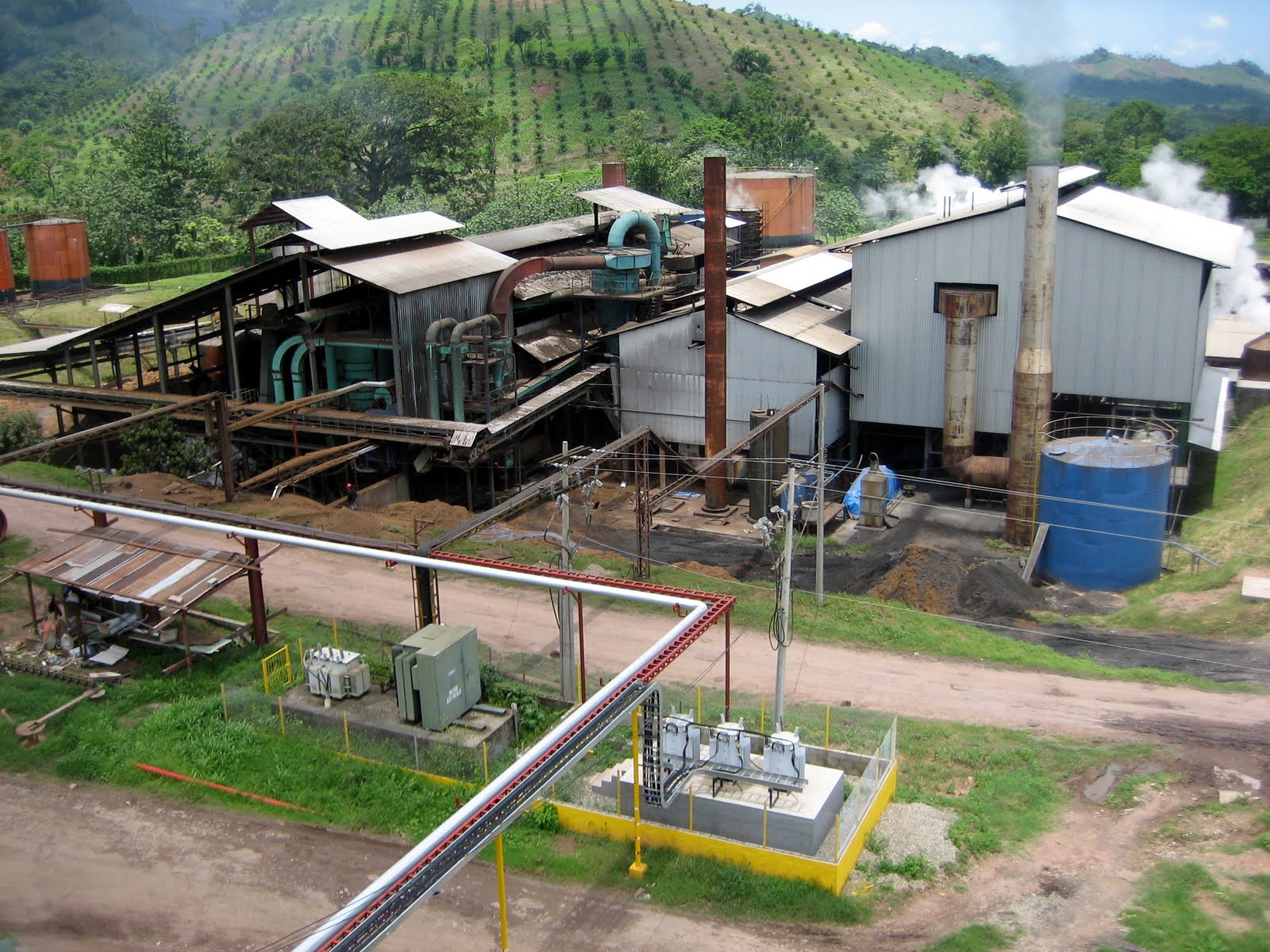
[The Palcasa plant for extracting oil from African Palms]

[You can see small, medium, and large trucks unloading raquis of palmas into large reddish brown piles.  The processing plant is owned by over 1000 farmers in a coop and it processes about 60 tons per hour.]

[The first step to extracting the palm oil: Raquis are queued up in giant hoppers and get dispensed into  carts mounted on railroad tracks.]

[The carts are rolled into steaming chambers where the fruit becomes sterilized. The steam also helps separate or loosen the fruits (palmas) from the raquis.]

At this point something clever happens. The fruit is separated from the raquis and goes onto further processing. The wasted biomass material left over from the raquis goes to a giant furnace where it is burned. From this they produce the steam used at the plant in addition to generating electricity with a steam turbine. They produce 3.4 MW of power this way (equals 34,000 one hundred Watt light bulbs).  The plant uses a lot of this power, and they sell the rest to the national electrical grid.  If they had to purchase this electricity it would cost them over $8000 per day!!

The nut is removed from the pulp and the two parts go their separate ways, never to be reunited. There is some crying at this point, and hugging, and taking of pictures with cell phones.  But eventually the pulp goes to have its oil extracted and the nut goes on for further processing.  The oil that comes out is a mirky orange substance about the color of a pumpkin. It's called crude oil at this point, and goes on to get filtered and sold. After the oil extraction, the leftover solid wastes join their raquis brethren in the furnace to be burned.

[The crude oil is stored in these tanks.  The hill on the right has a young plantation that is probably not yet producing fruit. The trees are planted in rows and columns 10 meters apart so that when they are fully grown their canopies will not crowd each other.]

[The nuts after being separated from the pulp] 

At this point the nuts are opened and the almonds are removed and crushed to remove the high value palmiste oil. I'm not sure how this is done; I think he said something about an army of ballerinas and Tchiakovsky at Christmas, but I may have missed something in the translation. After the oil is removed from the almond, what remains is a meal sold as feed for chickens and other livestock. The shell from the nut goes to the furnace.  Everything is used in one way or another.

[bags of chicken feed being loaded on a truck]

At this point in the process, every bit of the raquis has either been converted into a useful product for sale, or has been sent to the furnace to help generate electricity. But I haven't mentioned one other thing: the liquid wastes.  What can be done with the liquid wastes?  You guessed it! Make biogas! My favorite subject.

Each ton of fruit combines with water and produces one ton of "mud" which would, normally, be a waste product.  But the mud is allowed to cool and sent to one of four underground concrete tanks, each about the size of a football field. They are covered with an air tight, flexible cover which inflates with methane as hosts of methane-producing bacteria digest the amino acids in the "mud". 

[a vat of liquid waste "mud" from one of the extraction processes]
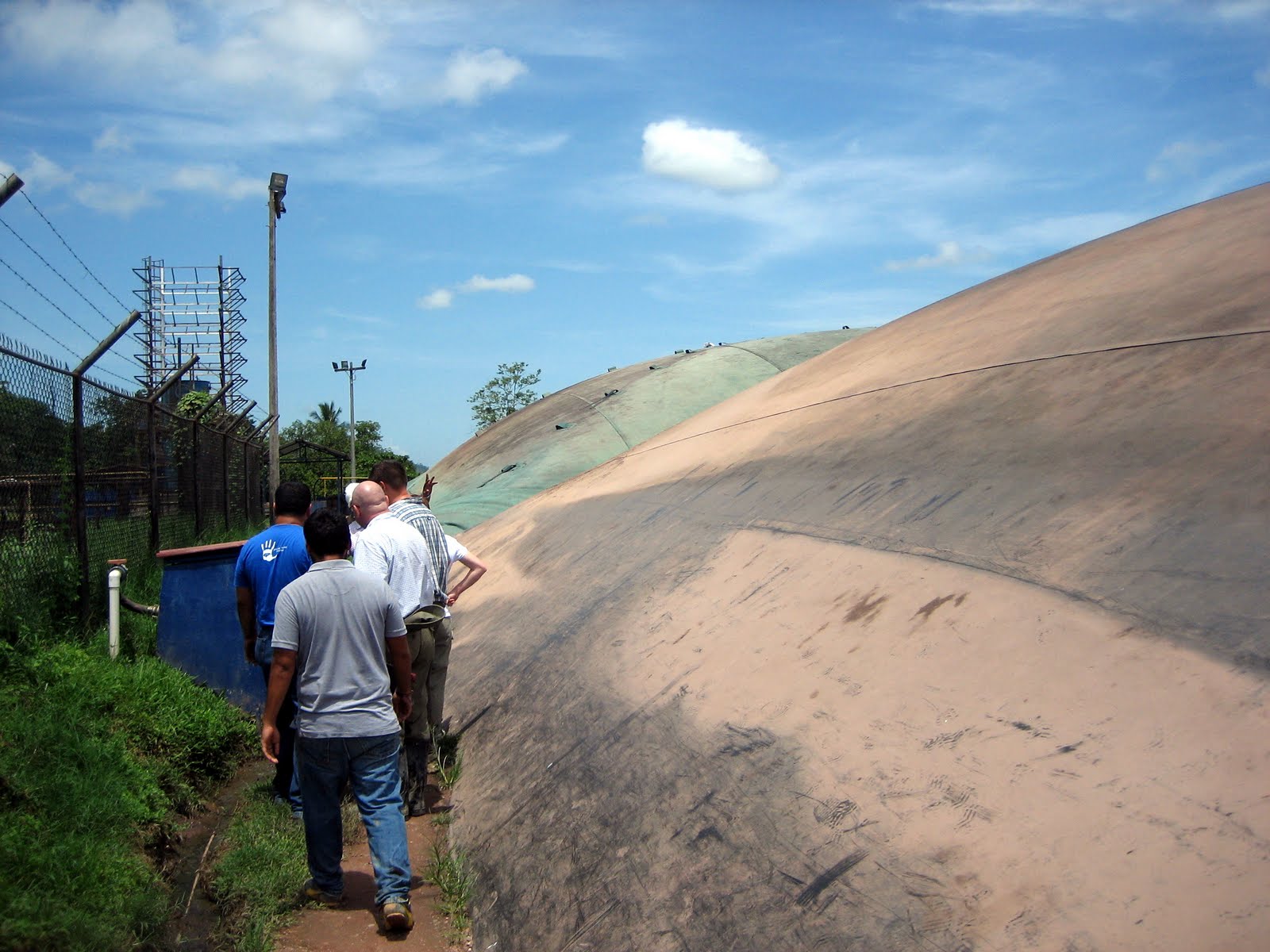
[These are the flexible membranes that collect the methane.  Although I didn't see any signs, I'm guessing this is a no smoking area.]

[The furnace that burns the solid wastes is about 30 feet tall.]

[Some of the char that comes out of the furnace is reused in the biogas process to help remove unwanted chemicals, specifically H2S and CO2.]

The presence of CO2 in the biogas dilutes the energy content of it, so it's good if it can be removed. The presence of H2S, however, is more sinister. It will mix with water to produce sulfuric acid, a nasty substance you don't want floating around inside your machines because it corrodes their internal parts.  After removing these gases, the biogas is largely methane (CH4) and can be burned in generators to produce still more electricity. This is also sold to the national electrical grid.  Furthermore, since their electricity production is so green, they earn carbon credits that are sold to Dutch companies who are required (by the Kyoto treaty, I think) to purchase them to offset their own greenhouse gas emissions.  Cha-ching in Spanish is cha-chinga.  OK, not really.

The Palcasa plant is doing an amazing job at using every scrap of the African Palm to produce renewable energy, multiple useful products, and tons of jobs for the country of Honduras. Other large processors in Honduras are following their example and converting their plants to operate similarly.  It's one of the most successful things I have ever seen in Honduras, and it's worthy of emulation and adulation.  Oh yes, and it softens hands while you do the dishes.


Thursday, August 18, 2011

Miscellaneous Images from Honduras

I spent a total of six weeks in Honduras this summer. My Spanish improved noticeably and I received my first and only complement on it by a Honduran national.  Then again, I only think he was complementing me.  I find it harder to understand than to mistakenly imagine I'm being understood.  

I got tiger-stripe tan lines on my feet from wearing my Keens and working outdoors. I even developed a little heat tolerance and have been able to endure the Texas heat much better since I returned (it's been 105 regularly whereas it was a cool 95 in Honduras).  I used to think that the idea of building up a tolerance to heat was a myth perpetrated by people who wanted to make me feel bad for using air conditioning. Well, maybe it is, but I have become a believer in the myth and in doing so received the unexpected benefit of being OK with the heat.  Of course, I lost about 30 pounds too, so that may have something to do with feeling cooler.

Here are some miscellaneous images from my time in Honduras.  None of them, by themselves, is adequate visual anchoring for a blog post of their own but together they weave a mismatched tapestry reminiscent of an engineer trying to dress himself...


[This is the biggest black plastic tank I could find.  They are made for drinking water storage, but we use them for other projects too. Our biodigester uses a 1,700 liter tank, but this Mother Ship is a 22,000 liter tank. "Maybe I could use it one day," he says to himself with a dreamy tone of voice.  I like this picture because it makes me look thinner by comparison.]

[I took this picture while I was waiting for the students to complete their white water rafting experience.  I was laying in a shady hammock on the banks of the Congreal river when I took it. The shoes are the Keens I mentioned from which I got my tiger stripes.]

[This is a toucan that lives at the Jungle River lodge and, apparently, likes lemonade.]

[I made a deal with one of my students: if I would go out into the (presumably) snake-infested gully to retrieve his misthrown Frisbee, then he would make my peanut butter sandwich. It turned out to have been a good deal, although I suspect I would have a different opinion if I would have had to use the machete in my hand to defend myself against like, a cobra or something.]

[We bought a dump truck load of rocks to form the base of our solar hot water heater.  It was kinda cool when they were delivered.]

[This is just about the last picture I took.  It's the sunset from Sambo Creek on the north coast of Honduras.]

Friday, August 12, 2011

Loma de Luz

During our most recent four week trip to Honduras, we visited a mercy hospital on the north coast called Loma de Luz (hill of light).  Our hosts were Brad and Trish Ward, who showed us great hospital-ality and brainstormed with us about future projects we could undertake together.  I was refreshed by this visit; I found kindred spirits, especially in Brad.  He and I spent a couple of nights talking late into the night about US culture vs. Latin American culture, about doing projects vs. building relationships, and about the sometimes unclear boundaries between capitalism, socialism, mercy, and kindness.  More on this discussion in another post coming soon to a theater near you.


[In the view from the top of the water tower at Loma de Luz you can see the Cayos Cochinos islands.]


[We toured the hospital that treats folks from all around the area.]

[Their facilities were nice and included a couple of operating rooms. They didn't let us operate on anyone.]

[The small (orange!) houses are for families with children needing extended treatments; think Ronald McDonald house.  The larger white house is a more permanent children's home that shelters vulnerable people like abused children, orphans, and women in crisis.]

[the front door to one of the little orange houses]

[This is Brad's "barn" and greenhouse.  He's making his own blend of fertilizer from manure, machette-cut hay, and biochar (like charcoal) for use with the acres of African palms you can see planted behind these structures. In the greenhouse he plans to build a system of hydroponics married with tilapia production.]


[Brad is experimenting with different chicken breeds.  The meaty breed used by McDonalds get so breast-heavy they can't even stand up.  I feel like that sometimes. He also has tougher free ranging chickens but they tend to smoke cigarettes and cuss a lot.  Maybe he can cross breed a happy medium?]

[Brad discusses his plans to use sheep to keep the grass down around the African palms, and to use free ranging chickens to keep the parasites down (they eat them out of the goat poop, mmm!). I tried to get a picture of Brad that was in focus but my camera kept focusing on the background, sorry.]

Tuesday, August 2, 2011

Promise Home Orphanage: Part 3, Biogas Generator

As I mentioned in my last post, the Promise Home orphanage endeavors to raise large quantities of tilapia to fund its operations. Tilapia is big business here in Honduras (where I have been for the last 3+ weeks).  In fact, today we had lunch a little restaurant called "La Rocca" where they pull a tilapia out of the tank for you, whack it on the head with a wooden mallet, and then fry it up!  Lunch with entertainment! You get the head, fins, tail, and a side of plantains.  It's not Tex-Mex, but I like it anyway.

At any rate, if you have a tilapia business you either need to drain the tank a few times per year to shovel out the poop (somebody call Mike Rowe), or build a self flushing type of tank as they did at Promise Home. Our project is to build a biogas generator to convert the fish poop into methane gas which can be used to heat water, cook, or generate electricity, for example.  After the tanks are "flushed" the contents go to a sediment tank.  The idea is to slow down the velocity of the water so that the "solids" sink to the bottom.  That's where we come in.  And I mean literally come in.

[William dons the waders in preparation to enter the sediment tank.  His matching hat was not planned, just a nice coincidence.]

[He's using a sump pump to vacuum the fish poop off the bottom of the sediment tank.  The water is not clear enough to see through, so you have to step around to feel where you have vacuumed and where you have not.  Squishy stuff underfoot = need to vacuum.]

[The green hose was 2" in diameter which made it pretty heavy and hard to manage when it was full.  We switched to a 1" black polyducto hose like the one in the foreground.]

[This is one of my favorite pictures, mostly for the gross-out factor.  This is where the sump pump empties into a 600 gallon tank. It's a fountain of renewable energy!  The tank is manufactured for use in collecting drinking water, and we cut the top off with a circular saw.  If the tank was square, we would use a square saw. Ba dump bump.  The black tank in the picture behind Tim will be inserted, upside down, onto the "fountain" and will fill up with sludge.  Being inverted it will be able to collect the gas produced without leaking.  It must all be kept in an oxygen-free environment on account of that's the way the bacteria like it.]

[We turned the pump off after about 500 gallons. Later we added a little lime water to control the pH levels and a triple dose of Rid-X Septic Tank treatment to try and jump start the bacterial growth.  Make my coffee a Rid-X triple shot low fat mocha with calcium carbonate sprinkles, por favor.]

Here's how it works.  First, a class of bacteria called Acid Forming bacteria break down the complex organic molecules into fatty acids.  Then a second class of bacteria called Methane Forming bacterial eat these acids and produce methane gas (CH4) as a byproduct. This is the same gas that we commonly refer to as "natural gas" and it can be burned in any of the same appliances such as burners, electric generators, etc..  For the last week or so, we have been monitoring the gas output, but it hasn't been the mother load of biogas that we had hoped for.  In fact, it's been just a trickle.  We're not sure what's wrong, but we know sometimes it can take weeks to get stabilized.  Stay tuned for more news on the fish-poop-to-renewable-energy project of the century!  Cue fish poop music in your mind.

Saturday, May 28, 2011

Mixed Emotions

Tomorrow is our last day in Honduras, and I have mixed emotions about it. In the last two weeks, we have accomplished much, and even finished our goals ahead of schedule. I have eaten lots of refried beans and plantains, and drank more than a few good cups of coffee.  I have enjoyed driving here, and listening to the students gasp at the Honduran driving styles and laugh out loud as they are tossed out of their seats on the bumpy roads.  Our team has bonded and drawn closer to each other and to God as we shared our life stories, prayed for each other, and worshiped with both our songs and designs. I don't want to "break up the party" by going home. I remember feeling this way at the end of summer camp as a kid. The extra-ordinary must again yield to the ordinary.  It's time to awaken from the dream. Can I press snooze?  And yet, at the same time, I miss my family. I miss reliable power and water, and I miss my own bed.  I even miss my dog.  So in another sense, I am ready to go.

I find that it is often the case that significant things (projects, relationships, or experiences) come with bitter sweetness.  Any married person will tell you that. Any parent will too. There is no perfect job or vacation.  But there are Good ones.  The genuine love for an imperfect family, or even a job, can be eternal and righteous anyway. On this trip to Honduras, I have gained the satisfaction of making our projects work; of keeping all the students alive and happy, in that order; of (perhaps just a little) inspiring them to think differently about how us nerdy engineers can do something of cosmic importance to build the very Kingdom of God; and I have made new friendships and strengthened others with half a dozen extremely talented students half my age and twice my IQ.

And yet, I find that it hurts a little. I know it will never be the same for this particular group. Even in reunions, it can never quite be recaptured. The life and community we have shared is like the sparkly stuff of fireworks: beautiful, yes, but short-lived. It is not insignificant, but it is ephemeral.

---------------

When I first started coming to Honduras, I would experience a very specific emotion at least once each trip.  I would find myself feeling like a pretender.  I would ask myself "What were you thinking? Who are you kidding to think you should even be here?"  I haven't felt that way in the last couple of years.  But instead a new tormenter has come. I have been feeling like a bad father and husband. Perhaps I have too much fun on these trips, and it seems wrong to ask my family to function without me while I go "play" for a while. It's hard on me when I know my family needs me, and there is nothing I can do about it because I am so far away.  At any rate, I can't seem to shake these darker emotions just under the surface when I am here.

Perhaps these are the "sufferings" in which we get to partake?  Paul said we get to share in the sufferings of Christ. Can't there be another way?  The tensions of family separation, of financial strain, of the heat and humidity and bugs and electricity blackouts and water shortages, and even the bitter sweet emotions of the end of a special trip - perhaps these are my share of His sufferings for now.  This knowledge helps it not to hurt so much.

Saturday, May 14, 2011

Packing for Honduras

It's the eleventh hour, literally, and I am nearly ready for our trip to Honduras.  The day or two before one of my trips is always the hardest part for me.  It's hard to leave my wife and boys.  I'm even going to miss the cat I recently dropped $500 to repair at the vet.  That's like, 9,500 Honduran Lempiras.  It sounds even more expensive that way. Good old Henry the cat.  I thought about taking him with me, or perhaps Maggie the Cocker Spaniel.  But she would bark at people on the plane...

"Sir, you're going to need to control your animal.  This barking is unacceptable and in violation of TSA regulations."

"Sorry, she just has to go to the bathroom.  Can we open the door and let her out for a minute?"

"Sir, we're at an altitude of thirty thousand feet."

"If I could just hold her rear end out the door..."

Right now, tumbling in the drier, are the lightweight quick-dry clothes that I always take with me. They can get wet (from rain, rivers, and sweat) and dry overnight.  My routine is to wear them right into the shower, wash them with a bar of soap, hang them up on a bungee clothes line. They're ready to wear by morning.

On the kitchen counter are the following items, in no particular order:

1) knee high rubber boots, size 13
2) two tool bags with hand tools, a soldering iron, a volt meter, and a laser tachometer
3) a bottle of Benadryl for allergic reactions
4) doses of both Imodium and ex-lax: the ones and zeros of engineering trips abroad.  I can't pack them next to each other because they would cancel each other out, leaving only empty containers and the fear of untreatable gastrointestinal distress.
4) the following books: "When Helping Hurts", and "Solar Engineering of Thermal Processes"
5) several thermocouples and a temperature-measuring data logger with a USB connector (check it out)
6) a very worn out baseball cap that has accompanied me on ever trip I have taken since 2006

After I got back from Kenya in 2006, I refused to put my ball cap in the laundry; how could I wash Africa down the drain?  A few years later, however, working in the heat and humidity of Honduras, my sweat soaked through the cap and mixed with this Kenyan souvenir. The muddy stain was gross, so I abandoned sentimentality in favor of hygiene.

By now, it is nearly midnight. I have procrastinated packing another hour by writing this blog post.  I'm thinking about going to Wal-mart to buy some sunscreen and travel snacks.  I'm too excited to sleep.

Tuesday, May 10, 2011

New Project in Honduras

In five days I leave for Honduras again.  Six engineering students and I will be at the Promise Home orphanage working on infrastructure projects.  This year we will be doing some electrical wiring for security lights as well as designing and testing a solar hot water heater.  They need a lot of hot water. An outrageous amount.

As part of their plan to be financially self-sustaining before they start taking in orphans, they have constructed several large concrete tanks in which to raise tilapia (the fish) to sell.  And it seems that the tilapia don't like cold water.  They grow much more slowly in cooler water.

"Hey mister, turn up the heat already. I'm freezin' in here!"

In fact, they grow about 10% slower for every 2 degrees F cooler than the optimal temperature, which is about 82 F.  And since this supposed to be is a money-making gig, not just an over sized aquarium, slow growing fish translates to less money.

Every day, they add fresh water to the tanks.  This water comes from a local river and has a temperature about 10 F below what the fish like.  So we are trying to help them slightly warm the temperature of this fresh water.  Sound easy?

The hard part is they need to warm 60,000 gallons a day!  That's the equivalent of an Olympic sized swimming pool every day and a half!

So we got together and started brainstorming about how to do this. We tossed around ideas like using a small fusion reactor, or buying 2000 hot water heaters from Home Depot and packing them in our luggage.  Nothing seemed practical.

But in Honduras they have an abundance of sunshine and humidity.  We can't use the humidity, but I think we can build a prototype solar hot water heater like one that might be used to heat a swimming pool.  But we can't build it all at once. Our plan is to build a prototype unit that can be replicated, perhaps many times, in order to get it big enough to heat the 60,000 gallons needed per day.

That's the goal. We have two weeks to do it.  More tomorrow.

Saturday, July 3, 2010

Now That I Can Finally Spell "Entrepreneur"...

After a half dozen trips into the developing world to implement small scale energy projects for impoverished people, one of my students (Ryan) and I decided the best way to increase our impact both in numbers of people and lifetime of the project was to turn our efforts into creating a financially self-sustaining social venture. That makes us social entrepreneurs. We are launching small energy companies in remote rural villages where people live without any power (and not much hope).

Regular readers (hi Mom) will recall that last November we entered and won a contest sponsored by the Inter-American Development Bank to bring energy access to those without it in rural parts of Latin America. Over 1000 groups entered the contest and yet, somehow, we won one of the 21 prizes for $200,000!! The only problem is, we can't use the money to pay salaries for expatriates or to buy a vehicle. These are two things we need with some urgency.

Along the way we picked up Brent, also a Baylor graduate and entrepreneur, as he came back from a two-year stint with the Peace Corps in Peru. In February, Ryan and Brent moved to La Ceiba, Honduras to start the Honduran company Energía Para Aldeas (which means Energy for Villages).

When I was in Honduras in May with another team of students, I got to meet with Brent and Ryan and also Sergio, our only full-time Honduran employee and good friend. In the pictures above: I'm the old guy, Brent is the good-looking one, Sergio is the brownest, and Ryan is the one who has gone native and now wears the Central American style hat and never shaves!

So where are we? We are struggling and a little bit discouraged. We are finding that, despite our experience working in Honduras, everything still takes longer than we expected. Everything. It's worse because the guys have to use the bus/taxi system to get around; we still haven't had adequate donations/investments to purchase a vehicle. They guys are renting a house that also serves as their office, and neither has air conditioning. When they need to get to a village they ride the bus out to the nearest point along the highway. Then they get off and walk the rocky roads up into the hills to where the villages are. Sergio has lost 40 pounds working with us! But they always have to watch the clock so that they leave in time to walk back and catch the last bus to the city. Either that or they have to come prepared to spend the night.

No one said this was going to be easy. And we aren't giving up. But we may have to make some changes soon. Stay tuned...

Friday, June 18, 2010

Isaac

This is one of my favorite photographs from my recent trip to Honduras. Isaac just completed his freshman year in the engineering program at Baylor, and has been eager to come on a discipline-specific mission trip since he first heard about them (which was before coming to Baylor). He says that he is at Baylor because of the existence of our group, Engineers with a Mission. It fits him.


Things you might not expect about Isaac from looking at him covered in sweat, dirt, and whiskers are: he is a well-read intellectual, a devout follower of Jesus Christ, and a surprisingly good dancer! The later we found out after attending a quinceañera which we had the honor of attending.

Monday, May 10, 2010

Honduras Bound

I am leading a new team of 10 engineering students and one faculty colleague back to Honduras next week. Lord willing, we will be installing a hydro electric generator in a new orphanage called Promise Home, near El Progresso. (See http://promisehome.org/ from where I borrowed the very cool logo. The white part in the hand is in the shape of Honduras, and the five stars are in Honduran flag.)
They already have a long section of PVC pipe (called a penstock) that brings water in from the nearby river. They also have already built a power house for our generating equipment. Below you see the inside of the power house. There are three pipes coming in from the river. The one on the left is 6" in diameter, the other two are 8". For the next year or two, we will only use the smaller one. After the water flows through the generator, it exits the power house via the concrete "bathtub" in the floor. There are two large drain pipes there that bring the water back to the river, downstream from our inlet.


This is the outside of the power house. You can see the 6" pipe running off to the river. The last image is a model of our "Pelton Runner" which is the water wheel gizmo that serves as the interface between our generator and the actual jets of water. Lance did a good job on this.


More posts about our trip coming soon!

Sunday, February 14, 2010

On Honduran Television

Ryan and Brent have been in Honduras for ten days now. They have had an eventful time (though there were no earthquakes or changes of government like last summer). They spent several days in Tegucigalpa, the capital city and home to our collaborative organization, AHPPER, a non-profit organization to promote the use of renewable energy sources in Honduras.

They also performed a repair on the hydro generator system in Danta Uno, bringing the system back online after one of our employees performed a "quick disconnect" of the generator to remove it from the river during a storm. Instead of disconnecting normally, he cut the wires. Apparently he was risking life and limb to do even this.

But after the storm, when the generator was put back in the river, the wires got crossed! This blew a circuit breaker (and perhaps something else - my data is a bit vague here) and they guys were left unsure of what to do next. Fortunately, Ryan was able to fix it in an afternoon. The reason this is fortunate is because the next day a television crew came to the village. AHPPER and other groups came and filmed a promotional piece that was shown on Honduran television a few days later! If we can get a copy we will post it.

Sunday, February 7, 2010

Ryan and Brent Move to Honduras

As of Thursday, February 4, 2010, Ryan and Brent have relocated to La Ceiba, Honduras to launch our business operations there as Energía Para Aldeas, which means Energy for Villages. The first task was to prepare for a meeting with a Honduran non-profit organization, AHPPER, with whom we applied for and won a large grant from the Inter-American Development Bank and GVEP International. Saturday night they met with AHPPER and went to one of our village systems, Danta Uno. A television crew came along and took video for use by the granting agency, GVEP International. In the evening they went back to our favorite restaurant in La Ceiba, a place called La Ponderosa. Our favorite waiter, Jorge, took care of them.

The plan for Sunday is for them to travel to Tegucigalpa, the capital of Honduras, to work with the AHPPER attorneys to get Energía Para Aldeas (EPA) legally incorporated and begin the process of getting residency for the guys.

Monday, November 30, 2009

The Rule of Law and Self-Governance Win in Honduras


Great news! The Presidential elections in Honduras went well and is being recognized by the US and by key countries in Central and South America, as well as Japan and Germany. This bodes well for the long-term stability of the country and for our work to bring electricity to rural communities there! Here is an excerpt:

"Almost 400 foreign observers from Japan, Europe, Latin America and the U.S. traveled to Honduras for yesterday's elections. Peru, Costa Rica, Panama, the German parliament and Japan will also recognize the vote. The outpouring of international support demonstrates that Hondurans were never as alone these past five months as they thought. A good part of the world backs their desire to save their democracy from chavismo and to live in liberty."

Saturday, October 3, 2009

More Insight from Mary O'Grady

Excerpts from: "Honduras Just Wants an Election"
September 30, 2009
Mary O'Grady of the Wall Street Journal

"Last week Tegucigalpa was under attack by zelayistas. They burned tires in the streets, vandalized property, looted businesses and blocked roads. But the U.S. repeated its support for Mr. Zelaya. Without producing any legal review, Washington decreed once again that a president who tried to trash the constitution must be reinstated or it will not recognize the November presidential election.

Why does the U.S. threaten to undermine a free election that would very likely restore peace and security? Venezuela's Hugo Chávez may have answered that in his speech to the United Nations General Assembly last Thursday. Taking the podium, Mr. Chávez told his audience that he didn't smell "sulfur" the way he did last year. This was a reference to his last U.N. tirade, when he called George W. Bush a devil who had left behind a sulfuric odor. This year, Mr. Chávez said, there was a smell of "hope."

Mr. Obama clearly has won acceptance from the Latin American tyrant and the U.S.'s Honduras policy has been helpful. But will this great honor last longer than a hiccup and yield any return? Probably not. Beyond sparing Mr. Obama the verbal barbs he delivered to Mr. Bush, Mr. Chávez shows no inclination toward being a good neighbor. He's engaged in a massive military buildup and he's even talking about his own nuclear ambitions.

The Obama administration's position on the Honduran election is embarrassing. Can anyone imagine that if Fidel Castro declared tomorrow that he would hold free elections and invite the whole world to come as observers, the U.S. would reject the idea because Cuba is a military dictatorship? It would be absurd."

"A transparent election is the path to political stability endorsed by the Free World. It is unseemly and churlish for the U.S. to threaten that process. Does Mr. Obama treasure kind words from Hugo Chávez that much? If so, we're all in trouble."

Wednesday, September 23, 2009

The Honduran non-coup

"I say 'Obama, let's go Obama! Let's work truly together to promote peace! But I hope, hope, hope to God ... that Obama could become the instigator for a process of internal change."
- Hugo Chávez, socialist leader of Venezuela, in his address to the United Nations, September 23, 2009

Are you, like me, dumbfounded at the Obama administration's position on Honduras? Do you wonder why they still refer to the outing of former President Zelaya as a "coup" when the Honduran Supreme Court, the Honduran Congress, and members of Zelaya's own political party have clearly shown that under the Honduran Constitution, Zelaya's own actions terminated his presidency? Do you wonder when Hilary Clinton became a higher authority in interpreting Honduran law than the Honduran Supreme Court???


The answer, seems to me, to fall into one of two logical positions. Either
1) Obama and Clinton are unaware of the facts, or
2) Obama and Clinton are choosing to ignore the facts for some other reason.

I find option one, ignorance of the facts, extremely unlikely on account of the emails I have sent the State Department explaining it to them. And if those didn't make it clear, perhaps the recent report by the Constitutional Research Service could offer a "serious legal review of the facts". Please, please read Mary O'Grady's recent article on this subject from where I borrowed the above political cartoon.

So it must be option number two. They are ignoring the facts for some other reason. Surely, it must be a good one. The evidence points to a political reason. Obama has chosen to put the rule of law on the back burner in favor of courting post-Bush political favor with the likes of Hugo Chávez, Daniel Ortega, and Raul Castro.
And judging by today's quote by Chávez, he's doing pretty well.

Monday, September 21, 2009

We Won It!

Our Honduran company, Energía Para Aldeas, is one of 21 winners of the Energy Innovation Contest sponsored by the Inter-American Development Bank. Over 1000 applications were submitted and yet we made it! "The king’s heart is like a stream of water directed by the Lord; he guides it wherever he pleases." Surely God's hand was upon us. We are so grateful to be able to join Him in what He is already doing in Honduras!

Our great partner in this endeavor is the Asociación Hondureña de Pequeños Productores de Energía Renovable which, in English, is the Honduran Association of Small Producers of Renewable Energy. They are a natural partner for us, having legal and environmental expertise in small renewable energy systems in Honduras.

FAQ:

Q: I thought your company was called Village Energy Inc. (VEI)?
A: Energía Para Aldeas is the Honduran company owned by the VEI, the U.S. company. Energía Para Aldeas, or EPA, means "Energy for Villages". Neither company is actually incorporated at this point, on account of we need some money. But both have a web presence, which makes us practically legit.

Q: Is Ryan moving to Honduras?
A: Yes. As soon as we can get him there. Hopefully he will be there by Thanksgiving, which is like, half an hour later than Thanksgiving in the U.S..

Q: Are you allowed to use the grant money to buy refried beans?
A: No, sadly.

Friday, September 11, 2009

Hillary v. Honduras

The Obama administration declares it won't recognize the results of a free and fair election.
by Elliott Abrams09/04/2009 11:40:00 AM
There is an obvious compromise available to end the Honduras crisis--or there was, anyway, until Secretary Clinton rejected it on Thursday. Honduras 's ejected president Mel Zelaya saw the Secretary and apparently persuaded her that the outcome of Honduras ' next elections must be rejected.
On what basis? None was stated, and no logical basis exists. The next elections will be entirely constitutional and held on time; and the term of office of the ousted Zelaya would end naturally and constitutionally when a new president is sworn in, in January.
The candidates were selected before the current crisis began, and all the parties—including Zelaya's Liberal Party, one half of Honduras 's essentially two party system--are participating. There is no reason whatsoever to doubt that the election can be monitored by international observers (and we could have demanded more of them than usual) and fairly conducted. Honduras 's vote for a new president on November 29 was the obvious way for everyone to dig out of the current mess without hurting the Honduran people and without damaging Honduras 's democratic institutions.

But it was rejected yesterday by Clinton and the Obama administration. The State Department's spokesman said that "Based on conditions as they currently exist, we cannot recognize the results of the election." The irrationality of the words is striking: based on conditions today, we can't recognize the results of a free election more than two months from now on November 29, even if everyone thinks it's free and even if Zelaya's party participates, and even if his term would constitutionally be over anyway.

Remember, it was Zelaya who wanted to screw around with that election, and hold a referendum on that date allowing him to be re-elected in perpetuity--just as his mentor Chavez has done in Venezuela . That's what gave rise to his defenestration. Now Hondurans want to go back to regular elections, but the United States won't allow them to do so?

The argument made around the Organization of American States (which is supporting Zelaya) is that elections conducted under the "de facto regime" cannot be considered fair.
Really? Every country in Latin America that made a transition from military to civilian rule held elections with the military still in charge, yet we don't hear the OAS saying all those elections were phony. Just to take one example, in Chile the dictator Augusto Pinochet was not only president when transition elections were held in 1990, he continued on as head of the armed forces for 8 years after that. Such history is forgotten at the OAS when it is convenient, but facts are stubborn things--even in Latin America .

Honduras was the original "banana republic," and its poverty remains extreme. Close to half the population lives on two dollars a day or less, and the country has not yet recovered from the devastation caused by Hurricane Mitch in 1998. The International Fund for Agricultural Development put it this way: "Rural poverty in Honduras is among the most severe in Latin America .
Approximately 53 percent of the population is rural, and it is estimated that 75 percent of the rural population lives below the poverty line, unable to meet basic needs. The country still has high rates of population growth, infant mortality, child malnutrition and illiteracy. These and other social and economic factors reflect its status as the second poorest country in the Western Hemisphere, after Haiti." Yet on Thursday the United States announced a cut of $30 million in aid and more aid cuts are in the offing. All this to shoehorn back into power a man whom the Supreme Court of Honduras voted, 15-0 (and 9 of the 15 were members of Zelaya's Liberal Party) had violated their constitution.

The Obama Administration's weak-kneed support of human rights in places like Egypt and China being obvious, the policy in Honduras appears to reflect not so much enthusiasm for democracy as a "no enemies to the Left" view of Latin America. One could laugh at the foolishness of this policy were it not for the six and half million Hondurans, fighting poverty, fighting Chavez and Zelaya and the effort to turn their political system into another Venezuela--and now, fighting Uncle Sam.

Elliott Abrams, Senior Fellow for Middle Eastern Studies at the Council on Foreign Relations, was Assistant Secretary of State for Inter-American Affairs in the Reagan Administration.

Monday, July 13, 2009

Jack's Place

Our lodging for this year's trip to Honduras was really nice. Twenty minutes' drive east of La Ceiba is a hotel named Villa Helen's Hotel & Restaurant. Jack the manager is French Canadian and the brother-in-law to Helen's husband (or some such relation). He also has the best English, so when we were there he was our main interface person. In our mind, it's Jack's Place.

It's right on the beach, yet reasonably priced. After a long day working in the villages, we would frequently return to our rooms and change into our suits for a swim in the Caribbean as the sun went down. It was a great way to cool off and relax before dinner and our evening meetings and tasks.

Diana, Lisa, Eduardo, myself, and Matt couldn't resist getting our feet wet when we first arrived. And as we stood there in the water, this is the view that we saw (below). Jack's Place had a iron fence with a gate; beyond the covered area is the hotel itself. Beyond the hotel is the highway, and beyond that are the mountains. Beyond that, eventually, is South America, but we couldn't really see it from the beach.

Under the red roof in the picture above were tables and hammocks! Oh man, the hammocks were nice. The sounds of the waves breaking would lull you to sleep.

Teresa is lounging and enjoying the view. She was one of my returning students. After Honduras she went to Houston for an internship in the natural gas industry.

Now this last photo is not one of the best in terms of quality, but I include it so you don't think we had it too easy! We did a lot of work as evidenced by the books and calculators on the table. Hammocks and fluid mechanics, baby. Engineering on the beach. Hands on the calculator, feet in the sand.