Showing posts with label spiritual. Show all posts

Wednesday, August 12, 2015

Solar Micro-businesses in Haiti

This May, Engineers with a Mission (EM), Baylor Missions, and Justice and Mercy Engineering Society, (JAMES) brought solar energy-based businesses to Ferrier, Haiti, one of the poorest areas of the Western Hemisphere. Mission Waco, the parent organization for JAMES, has had a presence in Ferrier for over 30 years and this was the third annual trip to the area. The longstanding relationships between Mission Waco and the Haitians there are the backbone for the development work done in north-east Haiti.


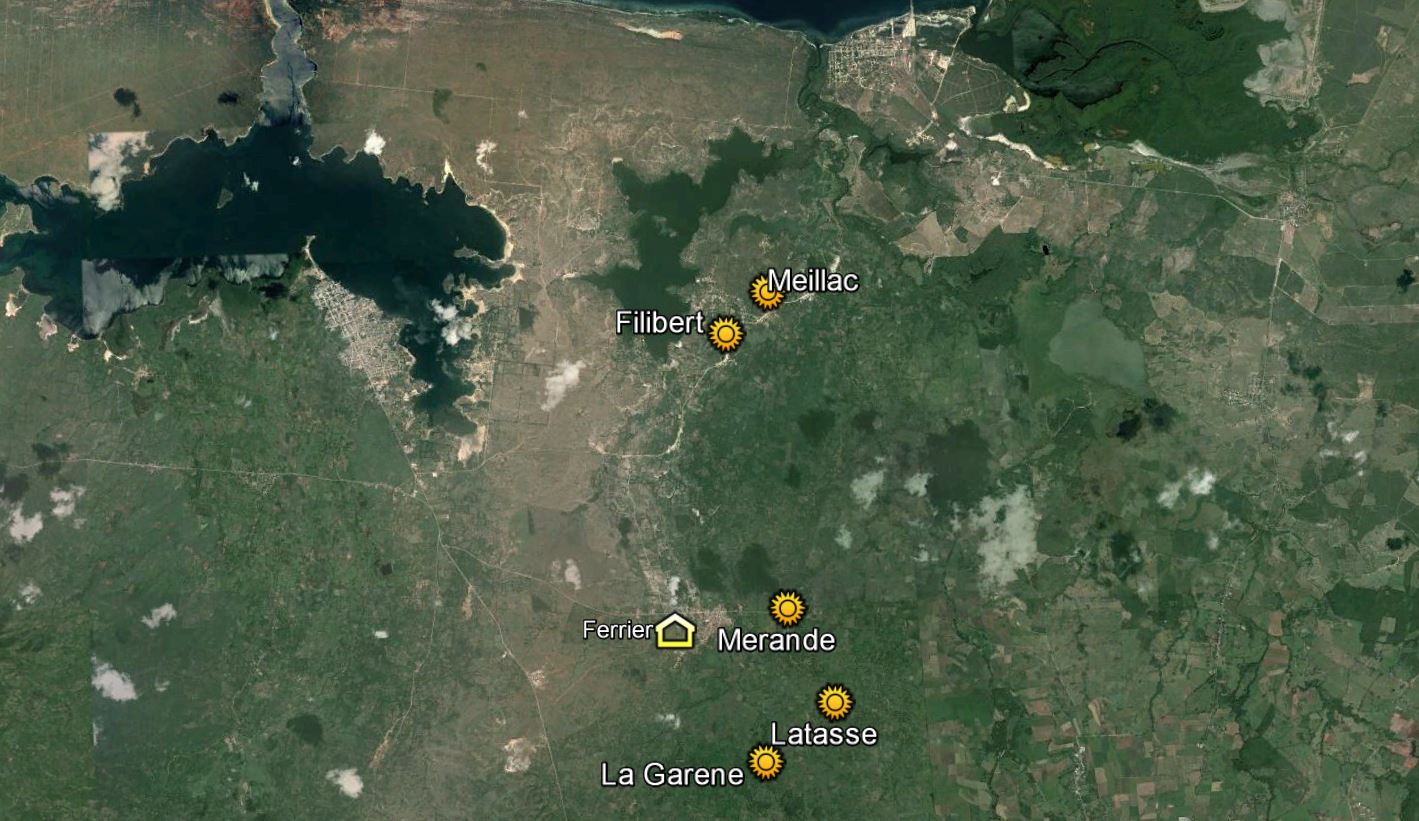
This year’s solar project was unique in that we had not one, but five installation sites in the areas surrounding Ferrier. We placed five 250 Watt solar panels in the care of carefully selected impoverished families to operate as cell phone charging businesses. These bless the families with a source of income and stimulate the local economy.  Although there is intermittent electricity access in the larger town of Ferrier, the outlying towns of Meillac, Filibert, Merande, Latasse, and La Garene have virtually zero access.  Cell phone owners must pay and often travel to recharge their phone battery.


Financial sustainability is an important goal for all our projects, even if we don't always achieve it. For this reason, we carefully chose to operate the solar systems as microbusinesses. An association was formed between JAMES and the five families, and a contract was signed. As part of their contract the families must pay 45 Haitian Gourdes from their daily earnings (approximately 1 dollar U.S.) as a rental fee. This fee is placed into a savings account to be used to cover future repairs and battery replacements. Borrowing an idea from the micro credit industry, the families have group liability for these rental fees – if someone can’t pay, the others are responsible for covering the fees. Ten weeks after launching these businesses, the rental fees have been 100% paid and about 3200 cell phones have been charged!  Another part of their contract requires that they use the energy they harvest to host gatherings for the community, whether it be setting out a light for children to do school work, hosting church activities, or simply letting the locals play dominoes at night.

[the indoor unit: charge controllers, switches, fuses, inverters, batteries, and a handy table top for holding phones while they charge]

[each family business also has a 250 Watt solar panel mounted near their home]

[part of the team, and seemingly most of the village, commissioning another system]

[while most of the solar panels were ground mounted, this home had a nice flat section of roof that was more secure]

These families were not selected at random. Our friend Zenas, a local pastor with a passion for serving the poor, chose these families because they are Christian leaders in their community. These solar panels are a tool for our Christian brothers and sisters to continue to bless their community.

This year we took a team of 16, 3 professors and 13 engineering students, forming our largest mission group yet. But our team was even larger than this! Our Baylor students worked right alongside local handymen, pastors, carpenters, guides, translators, and community members eager to help.

[Watching everyone do their part reminded us of the body of Christ;
everyone is different but each plays a part.]

We intentionally seek out locals to be a part of our team because it helps our team remain relationally grounded and helps further develop the community.  Hiring out Haitians is a way to provide a source of income to families as well as affirm their talents. One sweet example of this was when our guide and friend, Julio, came to the aid of one of our electrical engineering students who was struggling to eat a fresh coconut. He said, “Sarah, you may know electricity, but I know coconuts,” and then began to prepare the coconut. This story illustrates the interdependent relationships we want to cultivate. It is important that when we go into communities to tend to the physical ailments of poverty, that we do so in a spirit of humility, by understanding our own limitations and respecting the abilities of others.

[Coconut Sarah, myself, and most of the rest of the team]

Our work in Haiti is about more than creating clean energy, boosting the local economy, improving a family’s income, or exposing Baylor students to poverty - all of these are good and part of our trip. But it's also about God’s love for justice, restoration, and transformation in our hearts and the environment around us.  I am thrilled to be a part of it!

Wednesday, July 8, 2015

Seeing People, Not Poverty - a guest blog by Heather whom I like to call Karen

“We think sometimes that poverty is only being hungry, naked, and homeless. The poverty of being unwanted, unloved, and uncared for is the greatest poverty.”  
Mother Teresa

When the Haiti Engineering Team first embarked on our mission, I was bursting with the infectious excitement, enthusiasm, and anticipation that my teammates and team leaders had inspired.  The goal of our mission trip was to create and install five (5) solar-powered electricity systems that could be used to power microbusinesses for charging telephones and providing a small light source to rural villages with no access to electricity. 

Our adventure began in Puerto Plata, Dominican Republic, where we spent our first days gathering supplies, building mechanical solar panel frames, and testing electrical equipment.  On May 20, we continued our journey, crossing the Dominican Republic-Haiti border at Dajabon, DR. 

My excitement and hope was quickly replaced with fear and dismay.  The border crossing overloaded my senses.  People everywhere shouted for attention; children begged; porters forcefully offered their services; and border officials expected bribes.  The sun beat down mercilessly upon us, rotting trash that lined the streets and creating an unpleasant stench.  It was my first glimpse of true poverty and I recoiled in fear.  The stares of the local people made it clear that they saw us not as fellow humans, but rather as outsiders with money.  This made me cautious and uncomfortable and I reciprocated…I began to perceive them as poor people--peasants who would take advantage of me in an unwary moment.  Fortunately something happened to ensure this perception would not last.

When children came to beg us for money, my team leader picked up some pebbles and offered them to the children as a trade.  The children simply laughed at him, but it was enough to break the barrier…it was enough to make us all human again.  Before long, the children at the border were playing games with us, teaching us some Spanish, and learning small bits of English.  For a moment, our divisions and distinctions melted away.

Eventually, we moved through the border crossing and onto our final destination of Ferrier, Haiti.  Yet, that border experience was never far from my mind.  For me, it was an awakening…I had begun to understand the real tragedy of poverty.

Poverty is not a tragedy because people don’t have access to clean water, medical resources, housing, or adequate food—although these things are tragic in and of themselves.  They are the injustices of poverty.  The true tragedy of poverty is that it dehumanizes people.  Instead of seeing people who are afflicted with poor living conditions, we only see “the poor” or “the homeless” or “the hungry”, as if their condition is the only descriptor they merit. Genesis 1:27 says, “So God created mankind in His own image, in the image of God he created them; male and female he created them.”  If we are all created in the image of God, then we all deserve to be treated with the same dignity and respect, no matter our living conditions.

Somewhere along the way I had forgotten that.  In my desire to bring my own talents and resources to the aid of the Haitian people, I had reduced them to little more than a project—a problem for which I held a solution.  In doing so, I lost my own humanity.  For if I were stripped of those talents and resources, would I not then simply become a project myself?

For the rest of the trip, I took it upon myself to be the trip photographer, amongst other tasks.  I took photos of Haitians and BU students working side by side.  We had engineering talents and resources that the Haitian people did not have, but they had community and labor resources that we could not have provided.  The Haitian and BU communities drew together to shine our light, the light of Christ, so that all could see and give glory to our Father in heaven.  In these photos, I did not see poor people. I saw people of strength, courage, wisdom, community, joy, faith, hope, and love.  I saw God.

“Our deepest fear is not that we are inadequate. Our deepest fear is that we are powerful beyond measure. It is our light, not our darkness that most frightens us. We ask ourselves, 'Who am I to be brilliant, gorgeous, talented, fabulous?' Actually, who are you not to be any of these things? You are a child of God. Your playing small does not serve the world. There is nothing enlightened about shrinking so that other people won't feel insecure around you. We are all meant to shine, as children do. We were born to make manifest the glory of God that is within us. It's not just in some of us; it's in everyone. And as we let our own light shine, we unconsciously give other people permission to do the same. As we are liberated from our own fear, our presence automatically liberates others.” 
Marianne Williamson


[At the house of one of the families launching a microbusiness. Heather is in the red shirt on the front row.]

[Student team working alongside Haitians - hands and feet, eyes and ears]

 
 [Sonia (middle) is our only female-operated business person. Heather (right) and the other women found her to be inspirational.]


[We needed to bury the wires that ran from our solar panels to the batteries to protect them. Our Haitian coworkers could dig a trench and lay the PVC conduit very quickly.  They also could dig holes with unbelievably straight sides and mix concrete with expertise.]

Tuesday, July 1, 2014

My Recent Time Travel

The memorial service for my Aunt Francine was held at the First Baptist Church of Childress, Texas recently. She was my father's only sibling. Because of his Parkinson's disease, he was unable to travel the nearly 500 miles from Houston.  I went on his behalf and had a moving and profound experience as I visited iconic places of my childhood and tried to come to grips with my own mortality.  


Aunt Francine and Uncle Bill have lived on and operated a large cattle ranch outside Childress my entire life. It is remote, enormous, and beautifully rugged.  As a kid, I used to visit my cousins on the ranch - this was like visiting another planet in a time machine for a boy growing up in Houston.

[Cousins Amber and Ty both have families of their own now. I'm so proud of the people they have become.  I would like to write about them sometime, but that's for another day.]


At the memorial service, Ty read a passage from Aunt Francine's Bible, noting the words she had underlined and personal notes she had written in the margins. Seeing a Lieutenant Colonel in the Marines be emotional and vulnerable in front of the crowd was powerful and moving; it left everyone wiping their eyes.

After the service we drove back out to the ranch - for me it was like driving back in time. Very little has changed since I was last there 18 years ago at Amber's wedding.  In fact, very little has changed since I was a kid 40 years ago. Then and now, it's like it was when I was a child; you can still see the open land for miles in all directions.  There's a neighbor a mile or so to the east, another a mile or so to the west. It's rugged, expansive, beautiful, and almost timeless.  Almost.

[One of the views from their backyard]


[I remember being there in a thunderstorm in 1981 when this bell was hit by lightning.]

In the evening after the memorial service, we sat on the stone patio Aunt Francine made and enjoyed the view, the shade, the breeze, and mostly the family. I really enjoyed visiting with my cousins and their spouses and kids, and Uncle Bill, of course. It was hard, however, to speculate about the future with them. As our parents age, how do we respond?  How do we want our own children to respond as we, ourselves, age?

These are questions I have been wrestling with for the last few years in the back of my mind, but this weekend in the Texas panhandle brought them to the forefront with new poignancy.

I would have liked to spend another day with them, but I had to leave early the next morning. I decided to drive the additional 100 miles to visit Ralls, Texas where my father grew up and grandparents lived.


About halfway between the ranch and Ralls is a scenic overlook where the ultra flatness of the Caprock gives way to the rolling terrain to its east.  This is a special place for me; it's the place I proposed to Martha in the summer of 1992.  Again, hardly anything has changed there. The land stands in contrast to our lives; it moves at glacial speeds in comparison. Forty years ago this place looked exactly the same, except for some new wind turbines that peeked up over the horizon.

One of my imagined alternate lives would be to live there, owning and operating a wind farm. In fact, I even toyed with writing a novel set here.  I wrote a few chapters about an introverted engineer living here, but instead of ranching cattle like my Uncle Bill, he harvested the wind.  


On the subject of harvesting, when my grandfather died, my grandmother planted an oak tree in his honor at the little church he attended.  I had not seen the tree in a long time and I wanted to see how large it had grown to be.  As you can see, it's doing well!  I even took a handful of acorns to plant myself.


Before I left town for the long drive home, I visited the cemetery where my grandparents are buried. I felt compelled to do something that I have never done before. I stood at their grave and talked to them. I'm not sure why I felt I had to do this, but the feeling was strong, and the act was cathartic. I told them that their beloved daughter had died.  I know they already knew this because they are in heaven now, but I felt like I needed to give them the bad news somehow. I left a flower from her memorial service on their tombstone.

When I visited their grave, a wave of sadness overwhelmed me. I grieved for my aunt, my grandparents, my father's struggles with Parkinson's disease, and even the loss of my own childhood. My sense of adulthood, my sense of mortality, and the fact that even the seemingly unchangeable does, indeed, change and move on - these were overwhelming to me.  Standing in the cemetery with my camera in hand, I wept like a baby.


The Ralls cemetery has a new chapel and, just behind it, five large wind turbines: symbols that change really does happen, and also that it isn't all bad. There can be hope in change; things can really get better, they need not always decay.  This helps me accept my own aging and mortality. This helps me grieve the losses that inevitably come to us in life.

"You will be secure, because there is hope..." - Job 11:18

Friday, May 16, 2014

Compared to Magazines

As I write this I am preparing to lead a trip of engineering students on a two week trip to Haiti and the Dominican Republic.  I can't sleep.  I need to pack. My thoughts are racing.  So what do I do? In a fit of procrastination I decided it was time to write a blog post!

As I sit here at midnight I am listening to a song called "Mother India".  It’s one of my favorite songs. It's about the mutual brokenness of the third world and the first world.  It has been my observation that both of these "worlds" are really screwed up. Of course, Texas and Haiti, for example, are very different in some ways. I don't mean to minimize that. But there is a shared human experience in both of them. We're all really broken, but on us all are the fingerprints of a genius Creator.  The song captures this well and ends with a great hope.


Father God, you have shed your tears for Mother India
They have fallen to water ancient seeds
That will grow into hands that touch the untouchable
How blessed are the poor, the sick, the weak

The Serpent spoke and the world believed its venom
Now we're ten to a room or compared to magazines

There's a land where our shackles turn to diamonds
Where we trade in our rags for a royal crown
In that place, our oppressors hold no power
And the doors of the King are thrown wide 

My favorite line is Now we're ten to a room or compared to magazines.  Do you get it?  In the so-called "third world" people are often crowded into slums - a family of ten can share a 100 square feet. Poverty is horrible. And in the "first world" I know many folks tangled in the web of consumerism, comparisons, or body issues; a web spun by media marketeers. Our lives are constantly compared to magazines.  Both worlds are broken. There's wisdom in this song. I consider it an anthem of my calling.

"My calling"?  Isn't that a bit medieval, you say? What is that "calling" of yours, Mr. Joan of Arc?

I hesitate to write it because I might be wrong, or partially wrong, and embarrass myself in the future by saying it's such and such.  Or perhaps I will embarrass God if I say my calling is "this" when he's been trying so hard to get me to see that it's "that".  So let's put down some caveats.  This is what I think it might be, or perhaps it's just what I want it to be, or perhaps it's what I think it is tonight as I'm loosened up on Xanax.


[This is me being goofy at the Haitian elementary school to which we are bringing solar electricity next week! Photo credit: Angela Chancellor.]

In this part I'm going to refer to myself in third person 'cause there's no one else to talk to at this late hour.  
Is he serious? Why is he all "loosened up"?  Is he an abuser now? I don't think so.  It's not "abuse" if you have a prescription and take it per the doctor's instructions. The Xanax is for the insomnia he's been having lately. Even so, it makes me him a little buzzed and less inhibited. Will this help him write? Perhaps it will pharmaceutically dislodge his writer’s block like ex-lax for the blogosphere.

Why is he having insomnia?  It usually comes about this time of year (early May). This year he's busy with grading finals and helping his son with his Eagle Scout requirements and coordinating a dozen other engineers to go to Haiti in three days and teaching summer school and moving out of his house - all within a 60 day window. He's pretty stressed out. Oh, and he’s building a time machine out of discarded flip-phones fished out of a dumpster. Discarded flip phones are plentiful because of their obvious inferiority at wasting our time compared to newer touch-screen phones with way more apps.  

I'm going back to first person now.
My phone's touch-screen is broken. Not broken like the world, broken like glass.  I dropped it too many times and now the screen looks like a spider web. But it works just fine. It doesn't hurt my fingers to slide on the broken glass, and if I can't read something because of the cracks I just slide it up or down to a less broken spot.  I can waste time just fine. 

In this unfocused post I think I am trying to talk about what it means to have, and identify, one's calling. I do an amateur job of this in my freshman engineering classes helping students figure out that they can't all be Iron Man.  I paraphrase Frederick Buechner when I say God's calling for you is this: the intersection of your gifts, talents, and passions with the world's great need. In my class, I unpack this idea to help the students understand it.  But I don't have to explain what that means in this post because there's nobody reading this except me and the third person. I like writing in the third person.  How did I get in the third person, anyway?  Did he eat me?  Did I use a shrink ray to get really small so I could walk around in his guts and take selfies by his pancreas and stuff?

Yes, that's exactly what I did.

But seriously, to the best of my knowledge, I think my own calling, or the intersection of my gifts, talents, and passions with the world's great need is this:

to be Iron Man myself. 

No that's not right.

Wednesday, February 26, 2014

1969

In 1969 a baby girl and her family took a summer vacation at a dude ranch outside Del Rio near the Mexican border. It was a hot Texas summer and the family rode in a station wagon from their home in Houston with the convenience of air conditioning but without the inconvenience of seat belts. Once they got to the ranch, however, they rode horses with neither. Since the baby girl had not yet been born, she rode in her mother.  

This was Ross and Ginger's second marriage each. She brought one teenage daughter into the new family. He brought a daughter and two sons. They were very different people, but their differences fit together like pieces of a dysfunctional jigsaw puzzle. Both of them smoked a lot of cigarettes. This was before smoking was bad for you. 

Ten weeks before Ginger was due to give birth she went into labor at the dude ranch. They station-wagoned over to the nearest clinic in Del Rio and that's where Martha was born. Except her name wasn't Martha yet, because the doctor told the family that she would not live and advised them not to give her a name. She weighed less than four pounds and, like most premature babies, had underdeveloped lungs. The clinic lacked the equipment required to treat a baby this little. Since they didn't even have an oxygen mask small enough, they pointed a hose at her face and fixed it to the side of her little bed.  Her parents and brothers and sisters came to see her. Her skin was red and she had no fingernails. 

Her chest labored up and down as she struggled to breathe. 

Then something happened that is hard to understand. The family spent a few more days in Del Rio taking pictures of the little girl who would be named Martha and holding her. Then they left. They drove back to Houston and left her there to die by herself at the clinic. Undoubtedly, this was Ross's idea. The situation was too out of control for a controller like him to tolerate. But Ginger complied because she was powerless and afraid to refuse him. Leaving Martha behind was a source of shame for them for the rest of their lives.

They called the clinic regularly from their home in Houston to see how things were progressing and after several weeks the doctors became convinced she was going to live after all! Ross and Ginger drove back to Del Rio and brought Martha home laying on the front seat of their station wagon. They arrived on the day Neil Armstrong first set foot on the Moon. It was July 21, 1969.

---------------------------------------------------------

Forty four years later Martha is a grown woman with children of her own. I am her husband and we have been married twenty years.  Except for a couple of brief periods I'm not supposed tell you about, she has not smoked cigarettes, ridden horses, or been back to Del Rio.  She drives a high-mileage minivan which is like a station wagon only taller.

Over the years her mother's health degenerated; Ginger was spending week after week in hospitals and rehab centers to treat her COPD. All those years of smoking had ruined her lungs to the point that her breathing was shallow on a good day and full of suffocating panic on a bad day. Martha arranged for a nursing home in Waco where we live with our children and minivan. We moved her there and in a short time her strength and attitude improved significantly.  The nurses guiding her through her respiratory therapies would often tease her and laugh with her until her blood oxygen count reached 100%.

But the day after Thanksgiving, 2012, she had a flare up and had to be hospitalized, and it was then that we learned how bad her condition was. The doctors told us she had a 50/50 chance of making it through the night. She did survive that night, but the next day she and Martha decided the best thing was for her to enroll in hospice care.

[Martha visiting her mom while in hospice care]

Martha visited her every day for eight days. The morphine was a great help. Not only did it decrease the oxygen consumption of her body, it also calmed her fears and took away her panic. This was the most peaceful she had been in years. On the ninth day it seemed the end was near and Martha stayed with her around the clock. She stroked her hair, whispered prayers into her ears, and told her it was OK to let go. I came up to visit and bring Martha a change of clothes. Ginger laid on her back while Martha held her hand.

Her chest labored up and down as she struggled to breathe. 

That's when it hit me. Although Ginger had given up on Martha and left her to die as a baby, Martha refused to leave her mother. What a picture of forgiveness this was. What mercy I had just witnessed. What an act turning the other cheek. It left me speechless and I went home and wept for the beauty of it. 

"...as we forgive those who trespass against us"

She died the next day in Martha's company. It was days before I could talk about it without choking on my words, but eventually I pointed out what she had not noticed herself, the redeemed contrast of her own birth and her mother's death that I had observed. She was overcome.

Saturday, February 22, 2014

My Heroes

This post is a list of people I call my heroes. They have inspired me, or informed me, or encouraged me to one degree or another. Some of their influences affected me in earlier years of my life, some are still in progress. They have all had me in tears at one point or another, some many times.

I list them in no particular order.  About some I have much to say, others not so much.  Don't read anything into that. Their influences are all too multi-dimensional to make direct comparisons between them.

I must confess to you that I worry about making this public. It is my own weakness that I worry about what you think.  What if you hate them? What if you think they are trouble-makers, bigots, ivory-tower-ish, or self-righteous? What if you roll your eyes at my list? What if you think them pretentious and (gasp) me too by extension???  Well, so be it. These folks are awesome.

-------------------------------------------------------------------------------

Francis Schaeffer's books - how can I say it? - finally made sense of the world.  The first one I read was "How Should We Then Live? The Rise and Decline of Western Thought and Culture". It was a brief history of western thought, why it was great, where it went wrong, and where it is headed. In its few hundred pages, it transformed my understanding of philosophy, art, culture, politics, law, theology, and history. It put a big enough frame around them all that I could finally start making some sense of them all. He was a genius. I wanted to name my youngest son Schaeffer, but my wife was afraid he would be beaten up on account having a funny name.  So we made Schaeffer his middle name!


Nothing I can say is adequate praise for the Saint of Calcutta, Mother Teresa. Her devotion to the poor and marginalized (sustained for 45 years!) is nothing less than inspirational. I love this picture of her.


Rich Mullins was a musician whose life and lyrics communicated great spiritual depth and yet sincere humility. His authenticity and simplicity inspired me and challenged my suburban middle class life. There was a longing in his music, a hunger for something else over the horizon: heaven.

And if I sing, let me sing with a joy
That has born in me these songs
And if I weep let it be as a man
That is longing for his home


Bono is still alive, and therefore a potential threat to my hero list; he could still do something to embarrass me.  My first real connection to his music and message came in 1987, the spring of my freshman year of college when U2 released "The Joshua Tree". My roommate and I played it countless times and even today hearing it will evoke good memories from that time of my life.  Like MLK, Bono uses his voice both metaphorically and literally to "defend the weak and the fatherless; uphold the cause of the poor and the oppressed. [To] rescue the weak and the needy; [and] deliver them from the hand of the wicked" as Psalm 82:3-4 says. And like MLK, his motivation for this voice is born out of his grateful heart redeemed by his Creator. 
I was born
I was born to sing for you
I didn't have a choice but to lift you up
And sing whatever song you wanted me to
I give you back my voice
From the womb my first cry, it was a joyful noise...

Only love, only love can leave such a mark
But only love, only love can heal such a scar

Justified till we die, you and I will magnify
The Magnificent
Magnificent


Chuck Colson spent time in prison for his part in the Watergate scandal. In the midst of his arrest and sentencing he became a Christian. He founded Prison Fellowship to minister to the forgotten and the thrown away in prisons. His book "Loving God" changed the way I think about prisoners, human dignity, hope, and service.  His radio commentaries on science, culture, and apologetics picked up where Schaeffer left off.


I was five months old when MLK was assassinated. His eloquent and peaceful fight for justice has as its anthem the Bible verse Amos 5:24 - "But let justice roll on like a river, righteousness like a never-failing stream."  Justice matters. People matter. Human dignity matters.


My favorite author, Clive Staples Lewis, died on the same day JFK was assassinated. During college his books showed me that being a Christian and an intellectual need not be mutually exclusive, and that the growing chasm between my faith and my intellect could be closed. This was, for me, a reconciliation marked by enormous relief. His influence on my life has been more than significant.

One of my favorite quotes of his, one that is not well-known I think, particularly inspires me. It  reminds me of my father's struggles with Parkinson's disease: 

"But if you are a poor creature--poisoned by a wretched up-bringing in some house full of vulgar jealousies and senseless quarrels--saddled, by no choice of your own, with some loathsome sexual perversion--nagged day in and day out by an inferiority complex that makes you snap at your best friends--do not despair. He knows all about it. You are one of the poor whom He blessed. He knows what a wretched machine you are trying to drive. Keep on. Do what you can. One day He will fling it on the scrap-heap and give you a new one. And then you may astonish us all - not least yourself."
Italics mine.

Monday, March 19, 2012

What's all this "Justice" stuff anyway?

"...with liberty and justice for all."

As a kid I recited the pledge of allegiance robotically every morning before school.  Prayer had already been removed from this daily ritual by the time I was in elementary school in the 1970s, so the pledge of allegiance was the only thing we said.  But even without the prayer, the daily repetition did its job and caused the ideas of liberty and justice, perhaps too abstract for a kid to fully understand, to slowly soak into my innermost parts.  To what ever extent I could understand them, I learned that liberty and justice were important and to be valued at the highest levels. 


As the years went by, I continued to hear about the importance of liberty (freedom) and how the United States was "the" global example of a free country. I was taught to be grateful for our freedoms.  Example after example reinforced this value: one of the most symbolic icons of the United States is the Statue of Liberty, the Emancipation Proclamation is heralded as a great milestone in our history, and there are countless others.  Furthermore, in church I was given at least two important theological bases for valuing freedom: the work of Jesus was, in part, to set us free from slavery to our own sins, and secondly, our free choice to love God was what made our love real and not robotic.  Free will, freedom, democracy, these are at the heart of Western culture and especially America.


But I heard less about justice than liberty.  Justice is harder to define. When one celebrates "justice" it's usually because there was first an "injustice" that has now been remedied.  "Justice has been served" and similar phrases tended to make me think that justice was primarily punitive. That is justice, in my limited view, was performed by law enforcement officers, vigilantes like Clint Eastwood, and lawyers (at least the good ones) but not by everyday people.  I didn't hear much about justice in church either. When I read the Bible I found many verses expressing the value of justice, but I didn't hear many (any?) sermons on it. My friends didn't talk about it. "Hey man, how 'bout that justice, eh?" We didn't sing songs about it on the fourth of July.


But then, later in life, I started hearing about "social justice".  I had no framework for understanding what this was, how was it connected to punitive justice or biblical justice?  I found that other evangelical Christians were uneasy talking about it. It raised questions of "rights" and whether or not those rights had been violated. It seemed to be too much about pointing fingers and laying blame to be the topic of polite conversation.  And though the Bible had much to say about justice, it didn't use the term "rights" or seem to speak about justice in the same way. What was I to make of this?


During this week, I plan to write several posts about my personal journey to understand biblical justice and why it matters a whole whole whole lot. I will give you my amateur thoughts about the history of the church's teaching on justice in the United States during 20th century.  I will share my struggles on whether or not I can be a Republican and like social justice. And I will share with you something special that my students and I are doing, an event called "Camp [In]justice" later this week.

Saturday, February 4, 2012

U2 and Stravinsky: Kindred Spirits

Last night I read a fascinating article comparing U2 and Stravinsky. And Henry the cat thought it was the most interesting thing he ever saw in his whole life, ever.


Being on the faculty at Baylor University, I receive quarterly copies of a journal called Christian Scholar's Review. Each issue has half a dozen-ish articles from Christian scholars from all over the country.  Most of the time my cat and I can't even understand the titles of the articles; frequently they're high-level pieces on linguistics, or philosophy, or other topics outside my field of expertise. But once or twice a year an article captures my attention, reaches into my soul, and compels me to work past my unfamiliarity. The result is I do the reading-equivalent to sitting in the driveway, unable to stop listening to something on my car's radio.


For example, in 2003 I read an article called "Finding God in Prozac or Finding Prozac in God: Preserving a Christian View of the Person Amidst a Biopsychological Revolution" by Michael Boivin.  Are we still the same person if we alter our brain chemistry? Are we conformed less (or is it more?) to image of God when we use pharmacological assistance rather than when we languish in depression or anxiety?


Then in 2009 I read "International Development: Christian Reflections on Today's Competing Theories" by Roland Hoksbergen, Janel Curry, and Tracy Kuperus.  Are the prevailing theories about international development overly reductionist when they focus on culture, politics, economics, and geography?  ls their explanatory power limited by inadequate understanding of the whole person, an understanding of which the Christian worldview has much to say?


[My cat, Henry, helps me not take myself too seriously.]


Last night I read "U2 and Igor Stravinsky: Textures, Timbres, and the Devil" by Dan Pinkston.  It compared the Irish rock stars to the Russian composer and draws parallels in the way they favor texture over melody and harmony, both breaking tradition with the established norms of their times.  They even use similar musical "chords" that are not chords. The 0-2-5-7 pitches together, for example, defy the traditional naming nomenclature, being neither major nor minor, and are found in both their masterpieces,The Rite of Spring and Bullet the Blue Sky from the Joshua Tree recording. 


And at an even deeper level "...the way in which they respectively grapple with fame from the perspective of Christian faith is instructive. There is effectively a tension between fame and Christian humility that enlivens the music of both. Since neither U2 nor Stravinsky explicitly labeled themselves as 'Christian' artists, yet produced music that is at the forefront of their genres, they serve as models of how art of Christians can function outside the confines of the Christian establishment."


I agree. In fact, I would say that Bono (U2's singer) is a hero of mine because of the way he uses his gifts: influentially, outside the confines of the Christian establishment, and yet boldly fighting for that which is right as defined by orthodox Christianity. May I use my gifts half as well.


Near the end the article says "For both Stravinsky and the four members of U2, music was and continues to be a fundamental means of personal expression and inevitable vocation... Both U2 and Stravinsky have left us with a large body of work that is broadly influential, deeply human in meaning, an at times, exquisitely beautiful.  The spiritual substance of their output is also part of the lasting legacy. Works that artfully speak to the spiritual concerns such as joy, sadness, good, evil, longing, and praise will long outlive the musicians themselves."


While reading the article I thought of the U2 concert I attended a while back. I shot this video of the fans singing "Still Haven't Found What I'm Looking For". I used to not understand this song. It seemed to be expressing a dissatisfaction or incompleteness with the Christian faith, a dissatisfaction that apparently collided with the content of their other songs which embraced or defended it.  But finally I realized this song is about dissatisfaction with the world as it is today, full of problems and pains. He is singing about the longing for a better place. He is a sojourner in this world. He longs to live in heaven, in the Kingdom of God, where mercy and justice are not marred and polluted and his personal searching and striving can at last be satisfied.  Let it be, Lord.


Saturday, September 10, 2011

Hope "Falls" Eternal

I have a new level of hope in my life.  Not that I have had any deeply spiritual experiences or read something profound to give me this hope. I haven't seen an inspirational movie or been to a motivational conference.  It's much more shallow than that.  It's merely circumstantial, but yet it's there. I can't deny it. 

Here in Central Texas we have been a prisoner of war, and the war is almost over. It seems that the jail cell of Summer has cracked, and Fall has entered like an unlikely hero. "I'm Luke Skywalker and I'm here to rescue you."  And I am like Princes Leah, except with twice the body mass and cooler hair.

This year we smashed the record for the highest number of days above 100 F in a year: a total of 87 days.  I'm sure Al Gore is to blame, somehow.  The previous record was only 63 days, set back in 1980. It's been oppressive and seemingly unending.  It drains hope. But in the last few weeks it has finally cooled off so I've been spending more time outside, buoyed by a new hope.

And what have I been doing outside? Good things.

Today I finished the decking of an overly large, dangerously tall, and questionably safe tree-house in my backyard.  I'm embarrassed that it took me this long to get this far - so embarrassed that I am not even going to tell you how long it took.  And that's saying something. I like to make fun of myself in an attempt at entertaining you, the reader, but this is a sore subject for me. 

At any rate, here are some photos:

[Jono sits on the deck, waiting for adventure. The flag of Quebec flies proudly because... well, because it's the only flag we own that can take the rain.  Oh wait, I don't mean rain, I mean the water from my sprinklers, because it hasn't rained in a long time.  On the ground you can see my tools and an empty coffee cup, the icon of a good Saturday morning.]

[We haven't built any walls or rails yet, so you have to be cautious near the edges. It's a little spooky.]

[This is the view of my house, ORANGEHOUSE, as seen from the tree-house. It's not really orange anymore. It used to be, but we got a new roof. When we bought the house, the roof was a burnt orange color, just like the bricks and the shutters and the garage door and the trim and every paintable surface. In fact, it looked like someone spray painted the whole house one color, orange, so we called it "Orangehouse".]

[This is what it looks like up on the deck.]

[I used steel cables and turnbuckles to support the frame, just because they're cool. The other ends of the cables are mounted in the trunk of the tree with really big screws, also cool.]

[There is a cool branch that comes up through a cool hole in the floor.]

I have been told that people who live in cold climates get excited when winter finally cracks and spring starts to arrive. In fact, there's a great scene like that in "The Lion, The Witch, and The Wardrobe."  But for me, it's the reverse. Summer has finally passed. The back of the oppressor has been broken, and new hope has arrived.

What brings you hope?

Tuesday, May 3, 2011

This Chaos Production

Anxious, I lie awake
Tsunamis of troubles
My glacier is melting
On burst housing bubbles

I am quite powerless
Forced out of indifference
By what news men show me
Ads tell me my preference

Our oceans are plastic
Unnoticed malaria
Clean water in shortage
Islamic mania

Our systems are fallen
Erected by broken
Billionaires in Hummers
And junkies crack smokin'

My own heart divided
To eat snakes or salmon?
Do hungers control me
In spiritual famine?

Sweet Jesus have mercy!
This chaos production
Let your Kingdom come soon
Undo the destruction!

a poem by the Middle Aged Fat Guy

Saturday, February 27, 2010

Restorer of the Streets in Which to Dwell

A couple of Saturdays ago my 13 year old son David and I volunteered with a group from our church as part of a community cleanup day. Our church meets in an old grocery store that sat vacant for years in a run down part of town. The leadership chose the location in an attempt to "be where the need is" and, consequently, has attracted a diverse body of urban minorities, white suburbanites, and college students, most of whom recognize their own spiritual needs and are willing to help others shoulder their burdens. This unexpected composite is an imperfect image of a transcendent beauty which, prayerfully, reflects well on our common denominator: Jesus Christ.

The aim of this program is not only to help those in need to repair, clean, and beautify their neighborhood, but also to spark a sense of community, a sense of ownership and responsibility, and to impart hope through a helping hand. It's not just a hand out, it's a hand up.

My friend Mark was there leading out. That day we were cleaning a corner and power washing a house in need of paint. You can see the flecks of white paint on his face, but what you can't see is the water droplets in his hair, or the water-soaked gloves that made his hands numb on this windy winter day. You can't see (or can you?) his compassion and selflessness, or his humility. Neither do you see the coaching, support, and entrepreneurial insight he gave Ryan and I as we began our business, or the countless other ways he has served in our church. What do I see?

I see a man that fulfills what the ancient prophet Isaiah wrote of 2700 years ago:

"And those from among you will rebuild the ancient ruins; you will raise up the age-old foundations; and you will be called the repairer of the breach, the restorer of the streets in which to dwell." - Isaiah 58:12

Sunday, February 14, 2010

The Hole

I have been reading Richard Stearns's "The Hole in our Gospel". The hole to which the title refers is our responsibility as Christians to care for the weak, the poor, and the defenseless. I have been challenged.

Mr. Stearns is the president of World Vision, a huge non-profit organization that does all kinds of good for all kinds of people in need all over the world. For example, they help AIDS orphans in Africa with schools, food, and other care. When I first heard about the book I though it would be an encouragement to me. Perhaps I would receive kudos and encouragement for the work I do in Honduras. Yea for me, that kind of thing.

But this book has been "in my face" and "in my business" more than I expected! It's challenging. As a taste, let me quote a bit of it here. As if the story of the sheep and the goats (Matthew 25) wasn't challenging enough, Mr. Stearns has paraphrased it taking aim at the modern American church (and me):

"For I was hungry, while you had all you needed. I was thirsty, but you drank bottled water. I was a stranger, and you wanted me deported. I needed clothes, but you needed more clothes. I was sick, and you pointed out the behaviors that led to my sickness. I was in prison, and you said I was getting what I deserved."

Ouch.

Sunday, November 9, 2008

The Theological Rebar of Engineering

"I heard the rocks crying out,
'Be praised for all Your tenderness
by these works of Your hands
Suns that rise and rains that fall to bless
and bring to life Your land
Look down upon this winter wheat
and be glad that You have made
Blue for the sky and the color green
that fills Your fields with praise!'”

So sings the poet Rich Mullins in his song “The Color Green”[1]. Mr. Mullins was moved by the beauty he saw in creation and by what it revealed to him of his Creator. (see note A) The history of mankind is punctuated with similar responses to creation. And when engineers create, they echo the original creative Act.

In the book of Genesis we see two accounts of creation that reveal two independent characteristics about God. (Engineers might like to imagine these two characteristics along orthogonal axes: the axis of omnipotent creator and the axis of personal relater.) These two creation accounts are complementary and foundational and give us vital information about God and man.[2] Indeed, these two aspects of God and man (they are both creative and both personal) are multiplicative, sweeping out a product of rich and rewarding area. It is the goal of this essay to illuminate how engineering, as a profession, is well suited to join this song of creation with natural resonance and poetic elegance.

Genesis Chapter 1 describes how God created the cosmos out of nothing. The Hebrew name used for God in Chapter 1 is “Elohim”[3] which is a generic term for deity. He is portrayed as the Power that creates by His words alone and speaks into being the universe, the earth, and man. Verse 27 reads “And God created man in His own image, in the image of God He created him; male and female He created them.” Something of God is woven into mankind at his creation, though the depth of the meaning of “the image of God” has kept theologians busy for centuries. Regardless of its exhaustive meaning, man has an imprint or signature of his Creator that reflects some aspect(s) of Him, however imperfectly. Summarizing Chapter 1 then: Elohim creates everything, including, significantly, “man in His own image.” God is a creator and engineers are creators; the basis for an engineer’s creativity lies ultimately in this truth.

Chapter 2 of Genesis seems to rewind the story and retell it with an entirely new perspective. The narrative takes us back to before the creation of man and replays the events with much more detail (see note B). Firstly we notice that the name of God has changed from the “Elohim” of Chapter 1. Chapter 2 uses the proper name YHWH or “Yahweh” throughout. Yahweh has the meaning of “self existent One” and perhaps could be loosely translated “the One who was not created, but just IS.” In fact, God himself seems to place a special significance to this name later in Exodus Chapter 3, when speaking to Moses. Verses 14-15 read with italics added:

"And God said to Moses, “I AM WHO I AM”; and He said “Thus you shall say to the sons of Israel, ‘I AM has sent me to you.’” And God, furthermore, said to Moses, “Thus you shall say to the sons of Israel, ‘The LORD [Yahweh], the God of your fathers, the God of Abraham, the God of Isaac, and the God of Jacob, has sent me to you.’ This is My name forever, and this is My memorial-name to all generations."

So the name Yahweh is an important name and a personal name. The creation of man as detailed in Chapter 2 is personal as well: God took special care of Adam, placed him into Eden, spoke to him and gave him special tasks. In short, we see a personal side of God in Chapter 2. If Chapter 1 paints a masculine picture of God, Chapter 2 paints a feminine one. Indeed, today most scholars agree that it was Moses’ wife that made him put in all that personal stuff anyway.

So in the first two chapters of the Bible, we find two important aspects of the nature of God: He is a powerful creator and He is personal. To be a successful engineer, one must have these same two structural members in place. Engineers must be creative and they must be personal. To be successful along the creative axis, engineers need to have mastery of the technical tools of their field. To be successful along the personal axis, engineers must become effective communicators, have “people skills” and dispel stereotypes.

Perhaps the most common role played by engineers is that of designer. A “design engineer” is one that applies the skills of mathematics, the sciences, manufacturing technology, computing, etc., to the problem at hand. Problems addressed by design engineers include designs as large as battleships, as minute as integrated circuits, as complex as interplanetary probes, or as simple as ball bearings. The degree to which engineers understand mathematics, the sciences, manufacturing technology, computing, etc., is the degree to which they are free to operate, to design, to unleash their imagination, and create. In fact, they must understand that the delineations between these disciplines are themselves artificial.[5] Over-specialization can be a hindrance to creativity. Ultimately, truth is unified and reality is singular. Mathematics and the sciences could be viewed as different languages, but both attempt to describe that which is true. To create (design) in this universe means first to conform to laws of nature that exist. In summary, to score high on the creative axis, engineers must be adept with technical know-how, but such an engineer, if lacking personal skills, will be stereotypically one-dimensional.

Engineers, being human for the most part, have the advantage of being intrinsically personal. All humans are persons, but being human is not enough to be successful along the personal axis. In practice, engineers don’t sit around performing triple integrals in isolation. (Indeed, the vast majority of engineers don’t perform triple integrals ever.) Design engineers often interface with people other than their own kind: people from different educational levels, socioeconomic status, and throughout the managerial hierarchy. Engineers in industry routinely interface with people groups as diverse as sales and marketing, machinists, assemblers, technicians, executives, suppliers, and customers. Many smaller companies, especially “high tech. start ups” tend to revolve around their engineering staff. They form a technical hub from which the rest of the company radiate like spokes. Engineers must work well with each.

“People skills” are harder to define, and harder to quantify, than their technical counterparts. However, at the top of any “people skills” list would be communication, including oral, written, and graphical abilities, and the important ability to tailor content to the technical level of the audience – without condescension. Also important are the ability to deal with difficult people, the virtue of treating coworkers with respect, and even salesmanship (in the best sense of the word). When both the creative and personal skills are developed the engineer is “optimized” to echo something central to the character of God himself.

What then, are the implications to engineering educators? The obvious points of cultivating technical ability balanced by personal skills have already been made, and in fact, most engineering programs will have long ago purposed to incorporate these goals into their programs.
The engineering program at a Christian institution, however, is in the unique position of being able to provide the theological rebar that adds strength, motivation, purpose, and meaning to a career in engineering. Students don’t learn to solve engineering problems for the sole purpose of getting the promotion. Instead, they strive to solve engineering problems because in so doing they glorify God and serve humanity. As the last lines of Bach’s manuscript compositions read “S.D.G.” for Soli Deo Gloria (to God alone be the glory)[8], so engineers might similarly dedicate their work, and in a sense make it holy.

Finally, engineering educators should encourage students to look for career opportunities of significance. These may or may not be the most prestigious or most highly paid (see note C). As an example of an opportunity to display the beauty of creation through engineering work, consider magnetic resonance imaging systems. MRI instruments require the leading edge technology in several fields at once: superconductors, electromagnetics, and imaging. In this technical sense, they are beautiful and elegant. Radio photons at other “colors green” paint the body, one slice at a time, on a high-resolution digital canvas. Medical reconnaissance. The level of detail obtained inspires awe at the wonderfully made human body. Finally, and fundamentally, the very purpose of MRI instruments is to help heal the sick. Engineers working for an MRI developer, therefore, may be motivated on a daily basis by the technical beauty and personal significance of their work.

Engineering, as a profession, is well suited to emulate two of God’s primary characteristics: His creativity and His personhood. The daily activities of many engineers manifest these characteristics, and like the cosmic background radiation, ring and reverberate in response to God’s creative acts. Engineering educators might make it their goal to expose students to these concepts, develop their the personal skills not just their technical abilities, and encourage them to find employment and career opportunities that are multi-dimensional in their significance. These goals, if well cultivated, will yield a crop of young engineers empowered with motivation and purpose, poised to serve mankind, and tuned to sing with the entire universe to their Creator.

Notes:
A. Although some engineers might relegate “the color green” to a mere photon wavelength, none the less, it is a photon wavelength that sings at its unique, quantum mechanical pitch, to the glory of its Creator. “…if these become silent, the stones will cry out!”

B. This is a recurring literary structure found in Genesis. First, less important things are covered with broad strokes. This provides the setting into which fits the information more central to the overall theme of the Bible. The broad-brush information is dealt with quickly and moved out of the way. Then the more important information is expanded, detailed, and magnified as if focused upon with a zoom lens. Then the most central information within the central information is magnified. And so it repeats in a beautiful pattern: microcosm within microcosm. The creation of the universe in Chapter 1 puts man in his cosmic setting, and then more detail about the creation of man and God’s relationship to him is given in Chapter 2. See reference [2] from which this analysis draws heavily.

C. Engineering students should be exposed to the fact that job satisfaction has little to do with salary. However, salary issues are the source of much job dissatisfaction.[4] The reality baby should not be thrown out with the materialist bathwater.

References

[1] Mullins, Rich, The Color Green, from A liturgy, a legacy & a ragamuffin band, Reunion Records, Nashville, Tennessee, 1993, punctuation added for clarity

[2] Schaeffer, Francis A., Genesis in Space and Time, from The Complete Works of Francis A. Schaeffer: A Christian Worldview, Volume Two, A Christian View of the Bible as Truth, Crossway Books, Wheaton Illinois, 1982

[3] Ryrie, Charlse, The Ryrie Study Bible, New American Standard Translation, The Moody Bible Institute of Chicago, 1976

[4] Hardy, Lee, The Fabric of the World, Inquiries into Calling, Career Choice, and the Design of Human Work, Wm. B. Eerdmans Publishing Co., Grand Rapids, Mich., 1990

[5] Baylor News, Vol. 10, No. 8, October 2000, President Robert B. Sloan Jr., President calls for 10-year plan for University

[6] Veith, Gene Edward Jr., Postmodern Times, A Christian Guide to Contemporary Thought and Culture, Crossway Books, Wheaton, Illinois, 1994

[7] Thaxton, Charles B., and Pearcey, Nancy R., The Soul of Science, Christian Faith and Natural Philosophy, Crossway Books, Wheaton, Illinois, 1994

[8] Colson, Charles, from speech “Does Religion Belong in Public Life?” delivered to Detroit Economic Club, Cobo Center, Detroit Michigan, November 13, 2000