Showing posts with label justice. Show all posts

Saturday, December 17, 2016

Haitian Businesses Update

This week I had the opportunity to revisit the solar powered cell phone charging businesses we helped to start back in the Summer of 2015.  For the back story, see my older post.

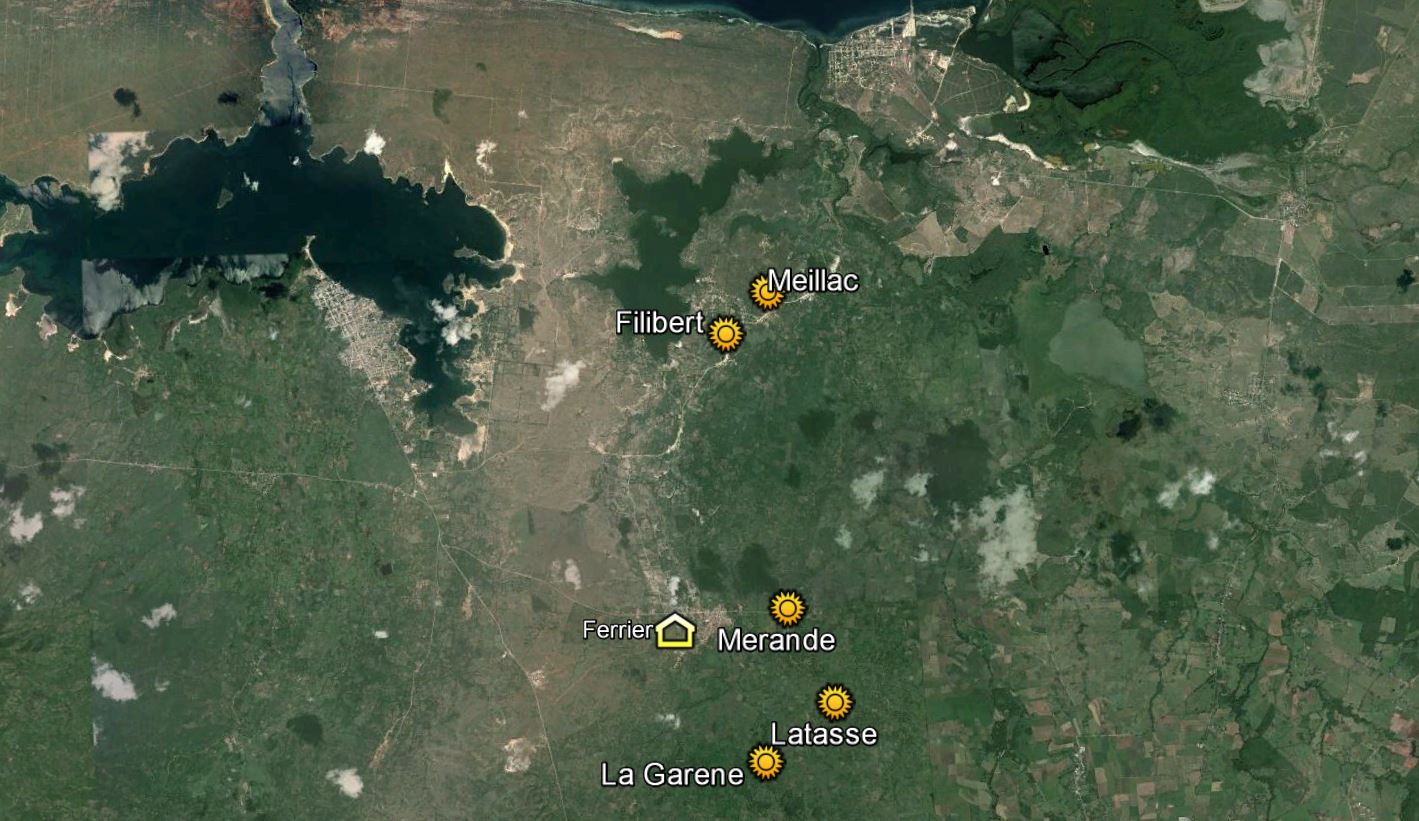
If you recall, or even if you don't, we launched a network of five family businesses in small villages around the area of Ferrier, in north east Haiti.  See the map below.  Of the four I was able to visit, all were in good working order but have had different levels of financial success. Read on to find out why!

[this is what it looked like out the window of my plane]

Business #1: Merande
The first business we visited was the closest to Ferrier: Merande.  It's at the home of a man called Lele, like a ukelele without the uke.  He is a gregarious man about my age. Talking to him tends to put me in a good mood because he's so welcoming and charming.When he saw me he said "mwen kontan we ou!" which literally means "I content see you".  I told him I was happy to see him too and he just laughed!  I guess he thinks it's funny that I try to speak Kreyol.

Lele had painted a sign outside his door advertising his business.  He references Psalm 23 in French which I believe says "The Lord is my burger" or something like that.  I don't speak French.

[marketing by Lele, store operated by Lele's son, cell phone charging for 5 Gourde or about a dime]

[The solar panel we put up on top of a frame was in good shape 
and was helping to provide support for a clothes line, #multitasking]

Despite the good working order of the equipment and the compelling signage advertising the business, he isn't making much money. Since our installation 18 months ago, the national electric grid has been extended to parts of Merande. Some homes have been officially connected to the grid, and many others have made unofficial (illegal) connections to it!  It's hard to sell something everyone is getting for free!  

Business #2: Latasse
Next, we drove on to Latasse. The roads were very muddy so we had to park and walk the last 20 minutes or so.  Once we arrived we found a similar situation.  Pierre was happy to see me, the equipment was working well, but business had slowed.  The grid hadn't been extended out that far, however, so what was the source of the competition?  

[Pierre and his storefront]

[pole-mounted solar panel, and two smaller solar panels from another Mission Waco program, see red circles]

Pierre had raised the solar panel on a pole to get it up out of the shade. That seemed to be working well although it makes rain the only source of cleaning.  But a more significant problem were the smaller solar panels such as those shown on the right.  Through another project with Mission Waco, a large number of these panels had been made available in Ferrier.  Apparently, some of them have found their way to Latasse and are now providing a new form of competition for the cell phone charging businesses.  They are not as powerful, but they are capable of charging one phone at a time. This is a second type of competition that didn't exist when we installed these systems!

Business #3: Filibert
Moving on to Filibert, we found the same thing.  Happy people, functioning equipment, and new competition.  Although they were making good income from the business (about $1/day) they said it was down some.  They said something about the Digicel tower further down the road, but I didn't understand.


[A new fence and a watermelon plant now keep company with the solar panel. The watermelon is another type of solar powered device.  It converts light to food.]

[Happy kids]

Driving a bit further down the road, however, we came to a new cellular antenna tower.  Digicel is a major cellular telephone company in the Caribbean and Central America and their new tower had its own large array of solar panels since there isn't any other source of electricity out there.  To keep people from stealing the solar panels they surrounded them with a concrete wall topped with razor wire and hired a security guard. We spoke with a woman nearby who told us the security guard was running his own cell phone charging business with the electricity from the tower!  Unbelievable. She also had a power cord stretched through the razor wire to power her house. Not immediately understanding why there was a power cord, I asked my translator, Guy, to inquire about it. He understood she was stealing power and didn't want to cause trouble by asking about it. He wisely put me off until such time that he could explain it to me discretely.  Maybe he was afraid the woman would beat me up if she thought I was from Digicel corporate headquarters or something.

[Laundry drying on the bushes near the base of the Digicel antenna tower]

[Digicel's large and expensive array of solar panels - and the source of both
 the neighbor's electricity and the security guard's side business!]

[Guy is keeping me from getting into trouble with this lady who only responded to the pseudonym "Heisenberg"]

Business #4: Meillac
Moving on to Meillac and our most successful business, we came to Sonja's house.  From the beginning of this project she seemed to be the most aggressive businessperson, the most sure she could make a profit, and the most remote.  These attributes are working well for her.

As we pulled up to her house, another woman was just leaving with her newly charged cell phone. Sonja invited us in and told us that she was making $2 or $3 a day with her business - easily double what we had hoped and budgeted!  

As she was 18 months ago, she still avoided eye contact and seemed to be uncomfortable talking to me (I have that gift with women) but she answered our questions.  In the pictures you can see that she is charging some of the batteries directly. That is, she has taken the battery out of the phone, presumably because she didn't have the correct adapters for the various types of phones, and has modified chargers by cutting off the phone connector and attaching the wires directly to the battery terminals. Ingenuity!

 [phones and phone batteries being charged, some by direct connection of wires without plugs!]

[Sonja's house with a roof-mounted solar panel]


[uncomfortable but important video interview with entrepreneur Sonja of Meillac, Haiti!]

Business #5: La Garene
We didn't have time to make the circuitous trip to La Garene. It takes 30 minutes to walk there from Ferrier (on footpaths) but nearer to an hour to drive there (on rough roads).  Because of its proximity to Latasse, my guess is that they would be in a similar condition.

So where are we?
What did we learn from this visit?  We learned that our engineering was pretty good: the electronics, panels, batteries, etc., have held up well.  We also learned that the owners still seem to like them and use them.  We also saw examples of how much ingenuity can be found among people in severe poverty. 

But most importantly, we learned why some of the businesses aren't making as much money as we expected. There are three new types of competition that did not exist when we installed the systems in May 2015:
1) extensions of the national grid which brought electricity to more homes through both legal and illegal connections - we can't really complain about this since any type of electrification diminishes poverty in a multitude of ways
2) small solar panels flooding the region from another, different poverty abatement project are also taking away business in some areas - while this is good for the region as a whole, it's not so good for our businesses
3) unsanctioned businesses operated by the security guard of another power source (Digicel).

And where do we go from here?
So what we need to do is identify new revenue streams (that's fancy business speak for ways to make money) that our businesses can harness in ways the competition cannot. If the small solar panels can't produce as much power, what services could we provide that use more power than that competition can provide? How about a "cinema" that shows movies on a television?  How about a barber shop that uses electric trimmers? How about a refrigerator that makes ice or cools soft drinks? Help us think of other businesses - leave it in the comments!


Saturday, April 2, 2016

Get pumped!

Those of you that read my blog regularly (ahem, Mom) know that I have had the personal delight and professional privilege of taking engineering students abroad for the last decade.  Most of the service-learning projects we have worked on have been small scale renewable energy projects that involved solar- or hydro-generated electricity.  But in addition to electricity, these trips have allowed me to get a taste - pun intended - of working on water projects too. Ba dump bump!

So over the last year or two, I have read a few books on water well drilling, aquifers, water treatment techniques, and even the issues of justice associated with water access. I began raising money to buy a water well drilling rig, and was grateful to receive a Baylor University Missions Research Grant to bring my coffers up to the $20,000 required. I couple of months ago I ordered one, and today I was able to bring this new drilling rig out to a friend's house to drill a practice well.  Five students and I spent the morning and afternoon assembling the rig, leveling the ground, and drinking coffee - not necessarily in that order. 

[Righty tighty lefty loosey]

 My goal is to learn the process of using it to drill boreholes in areas with water access problems. This practice well is for a buddy's large garden, but the next one will be for a colonia outside of Laredo, Texas.  A group of engineering students and faculty are planning to go there this July to drill a well for a community garden. At present, the colonia has to bring in water with trucks.  Because water is harder to access, gardening isn't being done, and other sources of food are far away; it's a true food desert.  We hope this well will help the community grow more fresh vegetables and brew more coffee - not necessarily in that order.

[It looks smaller and lighter in photos, as do I.  See the Bluebonnets and Indian Paintbrushes blooming in the background?  Ahh, springtime in Texas.]

Monday, September 21, 2015

The Whales, They Love Me

Three things made today a great day! Three things happened that punctuated my day with excessive exclamation points and weeping-for-joy emojis. Three brief surprises burst forth from the surface of a day, otherwise characterized as "pretty good," like three blue whales breaching the surface of the ocean, showing me their bellies and yelling in whale language, "we love youuuuuuu!"

It all started like this: I got up early (for a Sunday) and met a few hundred other folks for the Mission Waco Walk for the Homeless event at 8:00 AM. It was a walking tour to visit several of the organizations around town that provide services to homeless folks. It was part advocacy, part education, part cardio. As the crowd walked from the shelter to the food bank to the veterans services building and so on, a delightful group of bikers blocked traffic for us like motorcycle cops at a funeral. They did a great job keeping us from being run over by early service Episcopalians.

Then I noticed that one of the bikers was my friend Paul who has a cool beard and a pony tail and plays bass.  Sometimes his band, The 10th Leper, plays music at Church Under the Bridge.  All these things make Paul pretty cool in my book. But to top it all off like the whip on top of my low fat caramel macchiato - today I found out that he rides a Harley!

[This photo taken from Paul's facebook page is credited to Souther Photography]

He agreed to let me ride on the back of his bike for a few blocks and it was fun to ride in the open air on this beautiful morning in downtown Waco. Its engine grumbled "potato potato potato" noises like a panting dragon.  Bucket list.

After rejoining the crowd I had the privilege of walking alongside Judge Ken Starr. He and his wife Alice were also participating in the Walk for the Homeless, though sadly he missed the sight of me on the hog.  He was very interested to hear about what Engineers with a Mission had been doing in Haiti with JAMES and Mission Waco. He was particularly excited to hear about our new Humanitarian Engineering program at Baylor. He and Alice were so attentive and engaged, and their support means a lot to me. Towards the end of our conversation, he told me something very exciting! Unfortunately, I don't feel the liberty to put it on the internet!!  So the second high point of my day will have to be redacted like Hillary's emails released by the State Department.  He said ahey! you think you're clever getting past my redactions   and that kkdk alk kdakkllkja  aklsdfj.  What's that you say?  Anticlimactic? All that buildup just to be redacted?  Yes well, you're right, it is. What can you do?

[Left to right: Jimmy Dorrell, CEO of Mission Waco
Rob Wolaver, President of Texas State Technical College, Waco
Johnette McKown, President of McLennan Community College
Ken Starr, President and Chancellor of Baylor University
Photo courtesy of Dr. Adam Ecklund, and by "courtesy" I mean stolen from his facebook page without permission.]

The third highlight came later that afternoon. For reasons you might not expect, I purchased a handgun. In fact, I bought my first ever firearm, a .357 magnum revolver.  You see, ever since, like, three months ago when I started thinking about doing humanitarian work with water wells along the Texas/Mexico border, I have been thinking about snakes. In my search to buy a snake gun, I had the opportunity to fire a friend's .357 at night. In the darkness, it was easy to see the huge fireball shoot out of the barrel. And the sound was so loud that it literally made my ears ring. This induced in me some kind of testosterone power pose that normally only comes with watching Monday Night Football or using a large chainsaw. I was hooked after one shot like a junkie.  

[My new gun is on order and won't be in for another week or so. In the meantime, please enjoy this likeness of an European American Armory Corp. Windicator .357 Magnum Revolver.]

So there it is: my three awesome things that happened today. I realize, looking back on them, that these things paint a picture of me. I'm afraid they make me look a bit like a redneck. Not that there's anything wrong with that (jk, I think there is) but in my case, it is simply not true. I refuse, in fact, to be defined by political stereotypes or other social expectations. I simultaneously care about social justice but also own a handgun. I frequently have the privilege to converse with both homeless people and university presidents. I like Harley Davidson motorcycles, but never plan to own one. I am pro-immigration, but also pro-rule of law. I am neither a libertarian nor a socialist. I do, however, speak whale.


Wednesday, August 12, 2015

Solar Micro-businesses in Haiti

This May, Engineers with a Mission (EM), Baylor Missions, and Justice and Mercy Engineering Society, (JAMES) brought solar energy-based businesses to Ferrier, Haiti, one of the poorest areas of the Western Hemisphere. Mission Waco, the parent organization for JAMES, has had a presence in Ferrier for over 30 years and this was the third annual trip to the area. The longstanding relationships between Mission Waco and the Haitians there are the backbone for the development work done in north-east Haiti.


This year’s solar project was unique in that we had not one, but five installation sites in the areas surrounding Ferrier. We placed five 250 Watt solar panels in the care of carefully selected impoverished families to operate as cell phone charging businesses. These bless the families with a source of income and stimulate the local economy.  Although there is intermittent electricity access in the larger town of Ferrier, the outlying towns of Meillac, Filibert, Merande, Latasse, and La Garene have virtually zero access.  Cell phone owners must pay and often travel to recharge their phone battery.


Financial sustainability is an important goal for all our projects, even if we don't always achieve it. For this reason, we carefully chose to operate the solar systems as microbusinesses. An association was formed between JAMES and the five families, and a contract was signed. As part of their contract the families must pay 45 Haitian Gourdes from their daily earnings (approximately 1 dollar U.S.) as a rental fee. This fee is placed into a savings account to be used to cover future repairs and battery replacements. Borrowing an idea from the micro credit industry, the families have group liability for these rental fees – if someone can’t pay, the others are responsible for covering the fees. Ten weeks after launching these businesses, the rental fees have been 100% paid and about 3200 cell phones have been charged!  Another part of their contract requires that they use the energy they harvest to host gatherings for the community, whether it be setting out a light for children to do school work, hosting church activities, or simply letting the locals play dominoes at night.

[the indoor unit: charge controllers, switches, fuses, inverters, batteries, and a handy table top for holding phones while they charge]

[each family business also has a 250 Watt solar panel mounted near their home]

[part of the team, and seemingly most of the village, commissioning another system]

[while most of the solar panels were ground mounted, this home had a nice flat section of roof that was more secure]

These families were not selected at random. Our friend Zenas, a local pastor with a passion for serving the poor, chose these families because they are Christian leaders in their community. These solar panels are a tool for our Christian brothers and sisters to continue to bless their community.

This year we took a team of 16, 3 professors and 13 engineering students, forming our largest mission group yet. But our team was even larger than this! Our Baylor students worked right alongside local handymen, pastors, carpenters, guides, translators, and community members eager to help.

[Watching everyone do their part reminded us of the body of Christ;
everyone is different but each plays a part.]

We intentionally seek out locals to be a part of our team because it helps our team remain relationally grounded and helps further develop the community.  Hiring out Haitians is a way to provide a source of income to families as well as affirm their talents. One sweet example of this was when our guide and friend, Julio, came to the aid of one of our electrical engineering students who was struggling to eat a fresh coconut. He said, “Sarah, you may know electricity, but I know coconuts,” and then began to prepare the coconut. This story illustrates the interdependent relationships we want to cultivate. It is important that when we go into communities to tend to the physical ailments of poverty, that we do so in a spirit of humility, by understanding our own limitations and respecting the abilities of others.

[Coconut Sarah, myself, and most of the rest of the team]

Our work in Haiti is about more than creating clean energy, boosting the local economy, improving a family’s income, or exposing Baylor students to poverty - all of these are good and part of our trip. But it's also about God’s love for justice, restoration, and transformation in our hearts and the environment around us.  I am thrilled to be a part of it!

Sunday, August 9, 2015

The Story of JAMES

I laid in bed after midnight rearranging words in my mind, experimenting with the acronyms they formed like Thomas Edison and a thousand failed light bulbs. Then suddenly, one name made sense: the "Justice and Mercy Engineering Society" which had the acronym - can you believe it? - JAMES!  You had to use the "and" to make the acronym work, which was a little bit of a stretch, but I knew it wasn't going to get any better. So I literally sprung out of bed and wrote it down, proving its existence to myself like snapshot of a Sasquatch before it disappeared back into the woods of my cluttered, sleepy mind.

[most people don't know that SASQUATCH is, itself, an acronym]

JAMES is the progression of my personal mission to equip service-minded engineers and to use what I have learned to serve the poor. I think it is my calling.  (See this post about callings, Iron Man, and Xanax.) This mission has been evolved over the years, and has been embodied through extra-curricular, curricular, and now post-curricular organizations which educate engineers in various capacities.

The extra-curricular organization is Engineers with a Mission (EM) at Baylor University which I co-founded with students in 2004. EM helps students discover how their technical education and interests can be used for the Kingdom of God through annual service-learning trips to places like Kenya, Honduras, Rwanda, and Haiti. There have been plenty of posts on this blog about our trips and projects.  EM has grown steadily over the years but remains an extra-curricular program. 

[our biggest EM meeting ever in the history of EM meetings]

I happen to really like the millennial generation.  As generations go, their sense of community, relationship, and service gives me a glimmer of hope for our collective futures.  Sensing this growing interest in global, service-based engineering over the last ten years, I spearheaded the creation of a Humanitarian Engineering concentration at Baylor. This program provides a curricular outlet for students to develop their interests in development or missions into a full-blown career. It becomes official this fall, and we'll have our first graduates by May 2016. Students with this concentration will be well-suited for serving in a non-profit organization, supporting Christian missions, or working in the international development sector.  But unlike students starting at Exxon, or Apple, or Boeing, students with vocations in this non-traditional field of Humanitarian Engineering may need some help finding a job!  

So almost three years ago, I gratefully accepted an offer from the local non-profit Mission Waco Mission World (MWMW) to form "6:8 technologies" (which I later renamed JAMES) as a program under their non-profit umbrella.  Here's an earlier post about that.


So what do we do?  JAMES is a post-curricular effort to:
     1. Train engineers, technicians, and tinkerers to do solar projects as ministry within their own spheres of influence
     2. Help Humanitarian Engineers (degreed or not) to find employment through networking and other resources
     3. Use technology to advocate for biblical justice like Enik the sleestack philosopher.

Even as a new organization, JAMES has a strong infrastructure thanks to our parent organization MWMW. They have over 20 years of experience operating as a well-respected non-profit and are recognized as a Four Star Charity by Charity Navigator for maintaining the highest standards of financial responsibility.  Doing this four years in a row puts them in the top 7% of non-profit organizations!


But our partnership with MWMW is about more than just sound accounting and advice, it is about our complementary missions. MWMW’s mission statement is to “Mobilize middle-class Americans to become more compassionately involved among the poor [and to] seek ways to overcome the systemic issues of social injustice which oppress the poor and marginalized.” JAMES is an expression of this mission. We aim to “mobilize” those in the engineering and related professions “to do justice, and to love mercy, and to walk humbly with your God” (Micah 6:8 ESV) by designing and implementing tangible renewable energy and water projects.

On our website you can find a series of video lessons detailing how to design, size, and install a solar electricity system. The videos are taught by me and use a high-speed animation of me drawing pictures on a whiteboard, low budget style.  The website also has job-finding tools and other great content. Visit us at www.justiceandmercy.engineering. We also tweet about job openings in the field, issues of justice, and ministries that could use help @Waco_JAMES and on our facebook.


[example of YouTube-hosted whiteboard talks on solar electricity, they go fast 
but you can pause and rewind over the parts you need help with]

In support of these goals, we also offer consulting services. Let's say your group is supporting an orphanage in Guatemala that needs help with solar panels. We could do any of the following:
a) train your personnel to design and install themselves, with online and/or hands-on training
b) do feasibility studies, design the system, provide cost estimates, etc.
c) send an engineering student or myself to do the installation with your team
d) any combination of the above.

Keep us in mind when you or your group is doing any energy-related work abroad, we would love to work with you!  Together let's work for God's kingdom to come on earth as it is in heaven.