This morning was a cool, blue skied morning. It was that peaceful time of morning after the kids had gone to school and the rush of nine-to-five commuters had subsided, restoring quietness to the neighborhood air. It was the time of day I used to cherish as a child on the rare occasion when I was home. These days were different than holidays. On holidays, everyone was home, and the quietness was less quiet. But on school days, if I was home for some reason, I had an awareness of the neighborhood emptiness, of row after row of suburban houses, evacuated of other kids, and I felt like I was alone in the world like the sole survivor of a nuclear war or planet-wide alien abduction.
Today’s morning was like that. Teaching college affords me the luxury of flexible work hours and today I had a breakfast date with my wife. We drove a few blocks to a little Mexican restaurant behind the Midway Shamrock. Midway Shamrock still looks and sounds like a gas station, but you can’t buy gas there anymore. Now it’s just a mechanic’s shop owned by Jim and Carl. They stopped selling gas a few years ago as the price of oil got higher and more and more people started buying their gas at Wal-Mart or HEB.
Locating a restaurant behind a used-to-be gas station that’s now just a mechanic’s shop is not a good location. But Cesar Leal has cultivated customer loyalty by serving authentic mom and pop Mexican food to a Central Texas crowd of blue collar workers, suburban soccer moms, and newspaper reading senior citizens. Today I had a breakfast burrito with scrambled eggs, potatoes, refried beans, cheese, and pico de gallo. The onions and cilantro were strong in the pico de gallo. I could taste them in the air as I exhaled through my nose. This awareness of vegetables made me feel earthy somehow, like I was Juan Valdez growing coffee on the side of a mountain in Columbia. It was delightful.
Martha and I enjoyed an hour of uninterrupted conversation which was as rare as, well, something really rare. Not quite Christmas rare, but more than, say, full moon rare. Talking with her like that reminds me of when we fell in love. We used to sit in each other’s cars talking for hours, not wanting to stop until wee hours of the night. Today was like that. When we got away from the house, away from the kids and the phone and the internet, away from the dishes and laundry and piles of stuff on my desk, we quickly reconnected. Our hearts and souls reintertwined like a vine and trellis or like our bare legs under the covers on a sleepy Saturday morning. We are reminded why we love each other and that we are great friends. Our worlds become three dimensional again.
Customers have to get their own coffee refills at Leal’s, but I don’t mind. The simple, brown, ceramic mugs have an almost hand-made feel which contributes to the whole Leal’s experience. Getting out of my well worn booth to pour myself a refill can punctuate breaks in our conversation like double spacing between paragraphs.
Walk to coffee pot, pour coffee, enter enter,
aging parents, enter enter,
funny thing the cats did, enter enter,
thoughts about God, enter enter,
our boys bring us joy.
After a while I can neither tolerate any more caffeine nor procrastinate going to work any longer. My time with Martha has been as nourishing to our relationship as Cesar’s burritos have been to my body. I can’t imagine a better way to start my day.
Thursday, February 7, 2008

Wednesday, February 6, 2008
Thoughts about Writing
I got up the nerve to tell a colleague, who happens to be an English professor, that I want to write a book. I was having a pleasant lunch with him, and I didn't want to ruin it with a question whose answer might burst my bubble or tempt him to lie. But I asked him anyway, because I thought he could offer me some good advice. And he did.
He said the first thing to do was write regularly. Forty five minutes a day, five days a week, will get you a novel in a year, he said. Notice he didn't say it would be good.
Secondly, he said I should find a group to share my writing, and to share and receive feedback and advice. That, I do not have, other than my wife who loves everything I do, and this blog which receives scant, but appreciated, comments.
Third, he said to read a book called "Bird by Bird" by Anne Lamott. I bought it on Amazon and it came in today. I read three pages. It's hilarious.
Fourth, he said to identify books I want to emulate. I have identified the following:
1) Breath of Kenya by Charles Herrick,
2) A Man Called Daddy by Hugh O'Neill, and
3) perhaps Three Cups of Tea by Greg Mortenson and David Oliver Relin. (The conditionality arises from the fact that I'm only a few chapters into it, but so far it's great.)
They are all non-fiction blends of serious events but with humorous observations. That's what I'm shooting for. As an example, I want to give you an excerpt from A Man Called Daddy. This is just one of many such chapters:
Daddy Loses Consciousness
or
Of Jellybean Epics and Glassy Eyes
Psychologists who've studied the conversational styles of men and women agree on just one gender distinction. Women enjoy the aimless burble of talk, while men tend to see the conversation as goal-oriented - as in, "What's your point, pal?"
Maybe. Maybe not. I don't know. But I do know that any male-female rift is nothing compared to the conversation Grand Canyon between men and kids. Conversationally speaking, men and kids are so far apart no psychologist has ever had the guts to study the gap.
Consider: Men are the strong, silent type. Kids are the small, chatty type. Men are cut to the chase. Bing-bang. Speak your piece. Lose the palaver. Kids never met a tedious detail they didn't like. They don't know you're supposed to skip the boring parts. Their stories go all around the cobbler's bench or the mulberry bush, whichever way's longest.
...
Over the years, I've tried to follow kid stories that made the Odyssey look like a one-liner, stories so slow and serpentine that I wanted to cry out, "Wrap it up! What the hell happened to the bunny?" Not only did my eyes glaze over, my higher brain function glazed over, too. Once, while listening to Rebecca tell me a story about how she found three pennies and two nickels in her backpack and then Brian took one of the pennies and ran down the hall, I actually slipped into a quasicoma.
For a long time I felt guilty about my feelings. I was pretty sure it couldn't help a child's self-esteem for Dad to drift off during the story of Daniel and the raisins and how Blair tried to tie her shoe but wouldn't share her snack with Kate who hurt her hand and then did her homework with David's pencil. But then one afternoon I saw the light and realized there was no reason to feel guilty.
Josh and I were driving around town on errands when, with great enthusiasm, he started to describe an episode of The Dick Van Dyke Show he had seen last night... When I told him that I had seen the episode back in 1965 when I was his age, he merely said "That's okay, Dad," and plunged ahead...
That's when I saw the truth. I knew in a flash that his stories weren't supposed to interest or amuse or edify me. No, they were supposed to interest or amuse or edify him. Somehow, recapitulating a television show helped him shape his experience of it.
I don't presume to understand the psychological kick of telling a story that's boring your audience to death. But one thing was perfectly clear: As long as I was willing to sit there and play the role of audience, Josh was happy. I didn't have to actually pay attention. I just had to give him cover, be a warm body to whom he might conceivably be talking.
...
The point is that kids set out from day one to dismantle the logical man you have spent a lifetime becoming. I'd love to suggest you take a hard line here, stand by the idea of coherence, of making sense. Only one problem with that position. The guys who enjoy fatherhood are they guys who don't.
The guys who enjoy fatherhood surrender. Like a suspension bridge that sways in the wind to survive the storm, they go along to get along. They go with the childish flow, give up the need to understand in favor of an apprehension that is, in truth, deeper and, finally, more satisfying...
He said the first thing to do was write regularly. Forty five minutes a day, five days a week, will get you a novel in a year, he said. Notice he didn't say it would be good.
Secondly, he said I should find a group to share my writing, and to share and receive feedback and advice. That, I do not have, other than my wife who loves everything I do, and this blog which receives scant, but appreciated, comments.
Third, he said to read a book called "Bird by Bird" by Anne Lamott. I bought it on Amazon and it came in today. I read three pages. It's hilarious.
Fourth, he said to identify books I want to emulate. I have identified the following:
1) Breath of Kenya by Charles Herrick,
2) A Man Called Daddy by Hugh O'Neill, and
3) perhaps Three Cups of Tea by Greg Mortenson and David Oliver Relin. (The conditionality arises from the fact that I'm only a few chapters into it, but so far it's great.)
They are all non-fiction blends of serious events but with humorous observations. That's what I'm shooting for. As an example, I want to give you an excerpt from A Man Called Daddy. This is just one of many such chapters:
Daddy Loses Consciousness
or
Of Jellybean Epics and Glassy Eyes
Psychologists who've studied the conversational styles of men and women agree on just one gender distinction. Women enjoy the aimless burble of talk, while men tend to see the conversation as goal-oriented - as in, "What's your point, pal?"
Maybe. Maybe not. I don't know. But I do know that any male-female rift is nothing compared to the conversation Grand Canyon between men and kids. Conversationally speaking, men and kids are so far apart no psychologist has ever had the guts to study the gap.
Consider: Men are the strong, silent type. Kids are the small, chatty type. Men are cut to the chase. Bing-bang. Speak your piece. Lose the palaver. Kids never met a tedious detail they didn't like. They don't know you're supposed to skip the boring parts. Their stories go all around the cobbler's bench or the mulberry bush, whichever way's longest.
...
Over the years, I've tried to follow kid stories that made the Odyssey look like a one-liner, stories so slow and serpentine that I wanted to cry out, "Wrap it up! What the hell happened to the bunny?" Not only did my eyes glaze over, my higher brain function glazed over, too. Once, while listening to Rebecca tell me a story about how she found three pennies and two nickels in her backpack and then Brian took one of the pennies and ran down the hall, I actually slipped into a quasicoma.
For a long time I felt guilty about my feelings. I was pretty sure it couldn't help a child's self-esteem for Dad to drift off during the story of Daniel and the raisins and how Blair tried to tie her shoe but wouldn't share her snack with Kate who hurt her hand and then did her homework with David's pencil. But then one afternoon I saw the light and realized there was no reason to feel guilty.
Josh and I were driving around town on errands when, with great enthusiasm, he started to describe an episode of The Dick Van Dyke Show he had seen last night... When I told him that I had seen the episode back in 1965 when I was his age, he merely said "That's okay, Dad," and plunged ahead...
That's when I saw the truth. I knew in a flash that his stories weren't supposed to interest or amuse or edify me. No, they were supposed to interest or amuse or edify him. Somehow, recapitulating a television show helped him shape his experience of it.
I don't presume to understand the psychological kick of telling a story that's boring your audience to death. But one thing was perfectly clear: As long as I was willing to sit there and play the role of audience, Josh was happy. I didn't have to actually pay attention. I just had to give him cover, be a warm body to whom he might conceivably be talking.
...
The point is that kids set out from day one to dismantle the logical man you have spent a lifetime becoming. I'd love to suggest you take a hard line here, stand by the idea of coherence, of making sense. Only one problem with that position. The guys who enjoy fatherhood are they guys who don't.
The guys who enjoy fatherhood surrender. Like a suspension bridge that sways in the wind to survive the storm, they go along to get along. They go with the childish flow, give up the need to understand in favor of an apprehension that is, in truth, deeper and, finally, more satisfying...
Tuesday, February 5, 2008
We Got the Grant!
 We received confirmation that our team is to receive a grant for $50,000 to develop a microfranchise test bed in Honduras over the next 18 months! I am so excited that I could spit in Spanish. This means my family and I will be spending about six weeks in Honduras this summer, that we will have multiple teams of "Engineers with a Mission" students come to visit and assist, and, most of all, that we can build out a few village-level hydro power businesses in an attempt to combat poverty in the name of Christ. These, with prayers and sweat, will bring income to franchisees, improve the quality of light the villagers have, and save each family a significant fraction of their current energy bill.
By our calculations, a typical village family spends about $1.70 per week on kerosene for lanterns (like the ones in the picture) and single-use batteries for flashlights and radios. We think we can provide a superior quality of light, eliminate the indoor air pollution, and bring an intangible hope for the future for these families for $1.08 per week. And at this rate, the system can pay for itself in 2.5 years.
Let me share with you an excerpt from the grant proposal we submitted that paints a little background information.
Many of the poor of developing countries live in isolated mountainous communities without access to grid-based electric power. This is true in Central America, Peru, Chile, East Africa, Afghanistan, Pakistan, Nepal, and Papua New Guinea, among others. The decentralized nature of the population makes it economically prohibitive to connect them to their national grids. “For those without access to electricity, lighting is derived from a diversity of sources, including kerosene, diesel, propane, biomass, candles, and yak butter.”[1] Fuel-burning lanterns, perhaps the most common alternative to electric lights, have been shown to be a source of respiratory disease[2], contribute to environmental problems associated with fossil fuels and deforestation, and put significant financial strain on the impoverished[3]. Evan Mills, an expert on rural lighting in developing countries, states in his 2005 Science article, “The Specter of Fuel Based Lighting”[4]:
“Fuel-based lighting embodies enormous economic and human inequities. The cost per useful lighting energy services... for fuel-based lighting is up to ~150 times that for premium-efficiency fluorescent lighting… [this means the cost to acheive the same level of light for the poor is much higher than it is for you and me]
“By virtue of its inefficiency and poor quality, fuel-based light is hard to work and read by, poses fire and burn hazards, and compromises indoor air quality. Women and children typically have the burden of obtaining fuel. Availability of [electric] lighting is linked to improved security, literacy, and income-producing activities in the home. Fuel prices can be highly volatile, and fuels are often rationed, which leads to political and social unrest, hoarding, and scarcity.”
However, in Honduras, Peru, Chile, and Nepal, for example, hydropower is considered a significant natural resource
[5], although its large scale production plants primarily serve urban areas. This proposal describes the creation of village-level “pico-hydro” (smaller than 5000 Watts output power) systems that harness small mountain streams to produce electricity services in remote communities. Furthermore, the energy produced by these methods can be sold to consumers through a variety of methods thereby making possible both electric lighting and entrepreneurial opportunities simultaneously.
[1] Mills, Evan, “The Specter of Fuel-Based Lighting,” Science, Vol. 308, Issue 5726, May 27, 2005
[2] Sikolia, DN, “The Prevalence of acute respiratory infections and the associated risk factors: A Study of children under five years of age in Kibera Lindi Village, Nairobi, Kenya,” Japanese National Institute of Public Health, 51 (1): 2002
[3] Residents of the Nairobi slum known as Kibera, for example, told a member of this proposal team (in 2006) that they were spending $0.28 per day on kerosene for less than three hours of light. With average incomes near $1.00 a day, this expense is significant.
[4] Mills, Evan, “The Specter of Fuel-Based Lighting,” Science, Vol. 308, Issue 5726, May 27, 2005
[5] CIA - The World Factbook, https://www.cia.gov/cia/publications/factbook/geos/xx.html
I invite my readers, both of you, to comment on our plans. Specifically, please consider the following thoughts:
For many hours during each day, the power provided by the river will not be used. During daylight hours, the system will be used for some battery charging, but after that task is done the power will be wasted. This could be for as much as 12 hours a day. What are some other uses for which this power could be used? For example, how about a freezer that makes blocks of ice for "ice-box" style food preservation? Or how about a community water heater where people could wash their clothes in hot water, or take a warm shower? What about some argicultural process like a coffee bean drier or a rubarb deshucker? How about a chicken centrifuge that slings out eggs faster than hens could lay without it? Dang it Jim! I'm an engineer not a third-world subsistence farmer! A little help?
Saturday, February 2, 2008
Stump Removal
You must be a fan if you are reading my post about removing a stump in the backyard. Check back later after I post about brushing my teeth. It's sure to be riveting.
Anyway, two years ago, almost, a huge storm hit our town and uprooted lots of trees. I had a lovely red oak in the backyard, over 40 years old, that was left leaning like the tower of Pisa after the storm. Fearing that it would fall on my house, I cut it down. But the stump remains...
Until now. Today the boys and I drilled 1-inch diameter holes, a foot deep, into the stump. We drilled three more angled holes from the side so that they intersected deep inside the wood. We used a huge drill bit that made me feel every bit of a man. Next we flushed the sawdust out with a hose and filled the holes with little granules made of kryptonite or something. They are supposed to make the wood more porous, so that in a month we can chop and/or burn in out. We'll see if it works.

Anyway, two years ago, almost, a huge storm hit our town and uprooted lots of trees. I had a lovely red oak in the backyard, over 40 years old, that was left leaning like the tower of Pisa after the storm. Fearing that it would fall on my house, I cut it down. But the stump remains...
Until now. Today the boys and I drilled 1-inch diameter holes, a foot deep, into the stump. We drilled three more angled holes from the side so that they intersected deep inside the wood. We used a huge drill bit that made me feel every bit of a man. Next we flushed the sawdust out with a hose and filled the holes with little granules made of kryptonite or something. They are supposed to make the wood more porous, so that in a month we can chop and/or burn in out. We'll see if it works.


The Boys in Cub Scouts
In a few weeks D will have his "crossing over" ceremony. The Cub Scout pack sets up a small foot bridge in the sanctuary of the church that sponsors it. On one side the boys line up and slowly, one at a time, walk over the bridge to meet the Boy Scout leader, the Scoutmaster. There will be three Boy Scout troops represented on the far side, and each boy selects one. The Scoutmaster of the chosen troop meets the boy, removes his Webelos neckerchief, and replaces it with one from his troop. They have great ceremonies and make the boys feel like big stuff. I love it.
Speaking of big stuff, Jono got his Bobcat badge at the pack meeting last week. Again, with much ceremony, they had him come to the front. M and I stood behind him, but no other boys were there. They said some nice words and made him feel very special. He beamed.
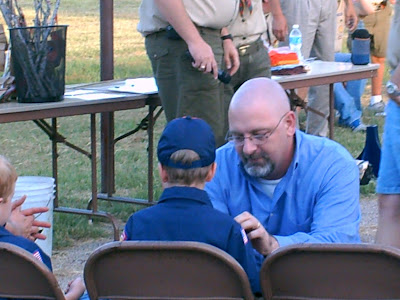
Speaking of big stuff, Jono got his Bobcat badge at the pack meeting last week. Again, with much ceremony, they had him come to the front. M and I stood behind him, but no other boys were there. They said some nice words and made him feel very special. He beamed.
Subscribe to:
Posts (Atom)